
The short answer
A hollow sound means a layer has separated. Either the top of the slab has delaminated from the concrete beneath it, a topping or overlay has let go of the slab it was bonded to, or the ground under the slab has washed out and left a void. Tapping, the shape of the hollow area and where it sits tell you which. Delaminated and debonded layers are removed and rebuilt; voids are filled and the slab lifted. Published GTA ranges, before HST: repair $7 to $15 per square foot of repair area, slab lifting $3 to $6 per square foot by mudjacking and $5 to $25 with polyurethane foam.
Three things that drum
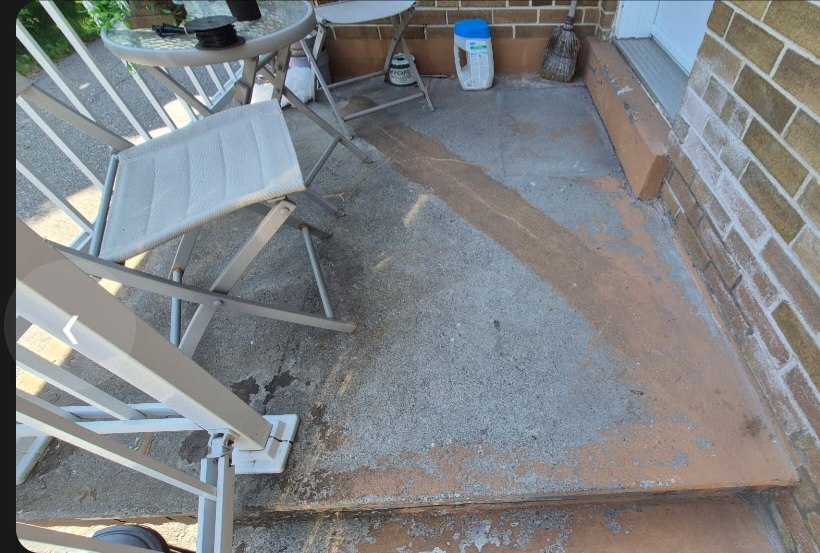
Solid concrete on solid ground gives a dull, dead note when you tap it. A hollow note means there is a gap somewhere under the point you hit, and there are three places it can be. The first is inside the slab itself: the top layer, often a centimetre or two thick, has delaminated from the concrete below it, usually because the surface was finished while bleed water or air was trapped under it, or because salt and frost have worked a plane of weakness loose. The second is between a topping and the slab: a stone-look finish, a thin overlay, a parging coat or a tile bed that was bonded to the concrete has let go, and the whole topping is floating. The third is under the slab entirely: the soil or fill has washed out or settled, and the slab is bridging a void.
How to tell which one you have
Tap across the area with a hammer or drag a chain over it and mark where the note changes. A hollow patch in the middle of an otherwise solid surface, with the surface still intact, is usually delamination or a debonded topping; if the surface is a different material from the slab, a stone finish, a skim coat, a tile bed, it is almost certainly the topping that has let go. Hollow that runs along an edge, a corner, a joint or the line of a downspout, with the slab perhaps a little low or tilted, points to a void underneath, because that is where water gets under a slab and carries the fines away. Cracks around the boundary of the hollow area and a slab that rocks when you stand on it confirm it.
Why it gets worse
A separation is a place for water to sit, and in Toronto water that sits freezes. Ice in a delaminated plane jacks the layer further apart each winter until the surface breaks up in sheets. Water under a slab keeps carrying soil out with it, so a small void becomes a large one and the slab, now unsupported, cracks along the edge of the void. A debonded topping holds water against the concrete beneath it and takes the surface with it when it finally lifts. None of the three repairs itself and all three are cheaper the year they are found than the year after.
The repair for each
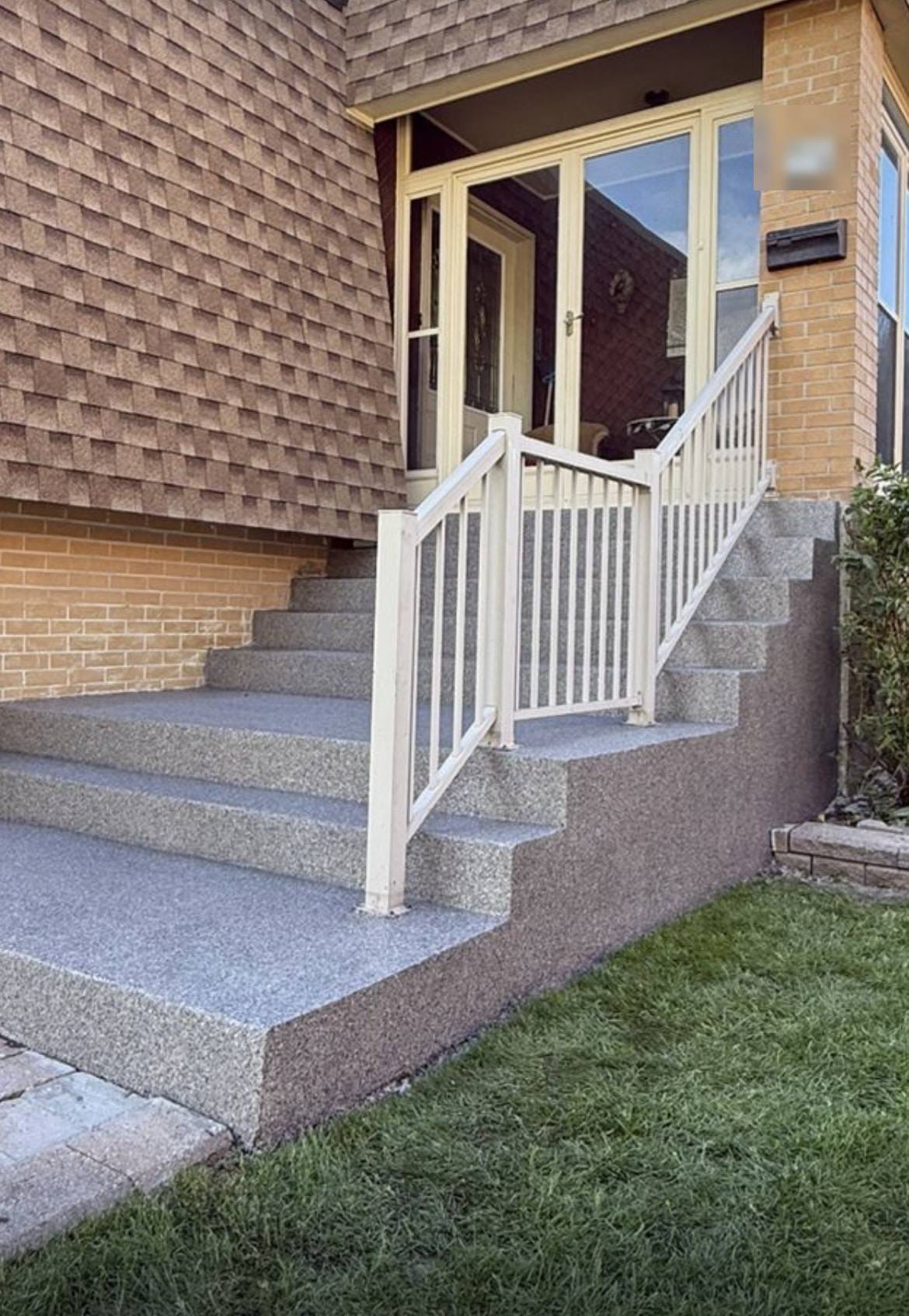
Delamination: the loose layer is removed back to sound, bonded concrete, the area is prepared and rebuilt with a bonded repair mortar or, where it covers most of a surface, the whole slab is ground back and resurfaced. A debonded topping: the topping is stripped entirely, because a topping that has let go in one place is letting go everywhere, the concrete under it is repaired and the surface is refinished in a system that bonds, which is what happened on most of the porch jobs in our gallery. A void: the slab is lifted back to grade and the void filled, by mudjacking or polyurethane foam injection through small holes, through our levelling partner, and then the joints are sealed and the water that caused it is sent somewhere else, because a lifted slab over the same leak settles again.
What it costs, in published GTA ranges
Repairing a delaminated or debonded area is priced on the area that needs work: the published GTA range for concrete repair is $7 to $15 per square foot of repair area, with a small-job floor of $500 to $1,200, and resurfacing a whole slab runs $3 to $10 per square foot basic. Lifting a settled slab over a void runs $3 to $6 per square foot by mudjacking and $5 to $25 per square foot with polyurethane foam, with a Canadian worked example of two 10 by 10 foot driveway sections lifted for roughly $800 to $1,200. All before HST, all market ranges compiled from published Canadian sources so you can sanity-check any quote, including ours; the full table and its sources are on our cost page.
Do not coat over it
The tempting fix for a hollow spot that still looks fine is a coating or a sealer, and it is the one that costs the most, because the coating bonds to the layer that is leaving. Whatever is hollow has to be dealt with first, and then the surface can be protected. If a contractor proposes a finish over a floor or porch without tapping it, tap it yourself before you sign.
Key takeaways
- Hollow means separated: inside the slab, between a topping and the slab, or under the slab.
- Where the hollow sits and what the surface is made of tell you which; edges and downspout lines mean a void.
- Water in the separation freezes and makes all three worse every winter.
- Delaminated and debonded layers are removed and rebuilt; voids are filled and the slab lifted, then the water is fixed.
- Published GTA ranges before HST: repair $7 to $15 per square foot of repair area, lifting $3 to $6 by mudjacking and $5 to $25 with foam.
Sources
The official and published sources this post relies on. Rules, fees and market prices change, so check the source before you plan around a figure.
- HomeStars: Understanding concrete contractor cost in Toronto, Canada source, as compiled on our cost page. Prices are quoted before HST.
- The Art of Concrete: Concrete repair cost in Ontario, what to expect, Ontario source, as compiled on our cost page. Prices are quoted before HST.
- ProJack Canada: How much does it cost to level concrete, Canada source, as compiled on our cost page. Prices are quoted before HST.
- Liftec: Mudjacking and polyurethane lifting, Southern Ontario, Ontario source, as compiled on our cost page. Prices are quoted before HST.
Frequently asked
Is a hollow-sounding slab dangerous?
A delaminated surface is a trip hazard waiting to break up, and a slab bridging a void can crack and drop under load, which on a porch or a walkway is a safety matter. Neither is an emergency the day you find it, but both are the kind of thing to deal with this season rather than next.
Can something be injected under a hollow slab?
If the hollow is a void under the slab, yes: polyurethane foam or a cement slurry is injected through small holes to fill the void and lift the slab back to grade. If the hollow is a delaminated surface or a debonded topping, injection does nothing; those layers are removed and rebuilt.
My porch sounds hollow but looks fine. Can I leave it?
You can, and it will not look fine for long. A hollow porch surface is usually a debonded stone finish or a delaminated top layer, and the next winters finish the job. Stripping and refinishing it while the concrete under it is still sound is the smaller job; waiting adds the repairs to the concrete underneath.
Will the hollow spot crack?
Eventually. A bridging slab cracks along the edge of the void; a delaminated layer cracks and breaks up in sheets. The crack is the second symptom, and by then the repair is bigger than it was when it only drummed.
 See it doneThe same Scarborough porch, stripped, repaired and finishedView →