
The short answer
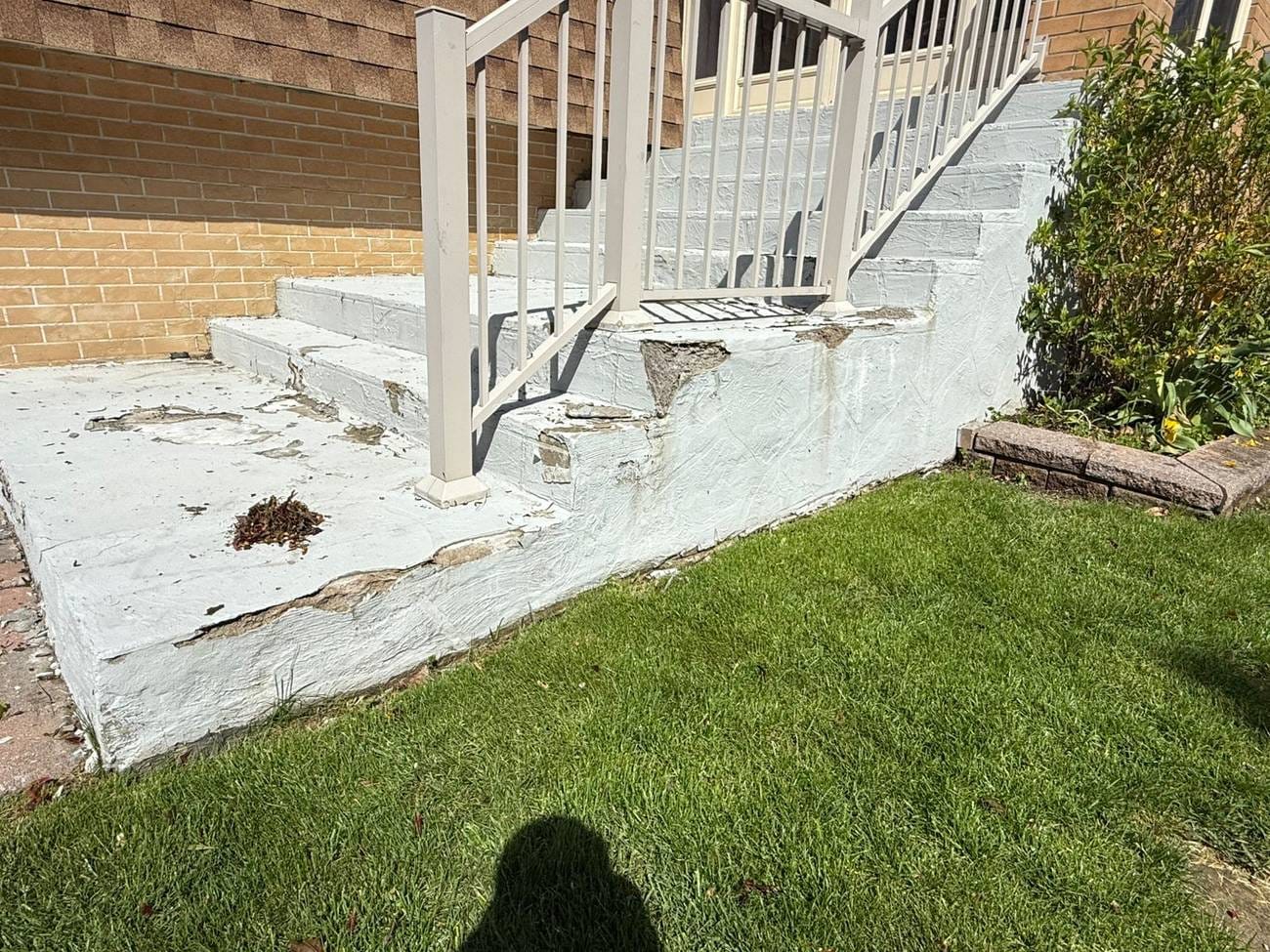
Jewel Stone is a decorative cementitious overlay, a thin, bonded layer of modified cement over your existing concrete. It looks excellent installed well, but as a cement-based layer it is porous: once water gets through or behind it, Ontario freeze-thaw pops it off in flakes and sheets, usually starting at step edges. A failing Jewel Stone finish cannot be repaired by coating over it. The loose material has to come off completely, the concrete repaired, and a new finish applied to sound concrete. On our jobs that finish is typically a polyaspartic full-flake system, which is flexible and UV-stable rather than another rigid cement layer.
What Jewel Stone actually is
Jewel Stone is a brand of decorative cementitious overlay hugely popular across the GTA for porches, steps and walkways, a thin layer of polymer-modified cement, troweled over existing concrete and finished to look like natural stone. Installed well, on sound concrete, it genuinely does look the part, which is why so many Toronto porches wear it.
But it is still cement. It is porous like cement, rigid like cement, and bonded to whatever the installer prepared, or did not. Those three properties write its failure story in this climate.
Why it fails here
Water finds its way into a cementitious overlay two ways: down through the surface as the sealer wears, and in from the edges, step nosings, cracks, and the joint where the overlay meets whatever is next to it. Once water is between the overlay and the concrete, every freeze pries the two apart. The overlay lets go in flakes first, then in sheets you can lift by hand.
Step edges go first because they get the most water, the most salt and the most mechanical abuse. A hairline crack in the overlay follows any movement in the concrete underneath. And where the original surface preparation was thin, a very common corner to cut, the bond was never strong enough to argue with ice in the first place.
None of this means the installer was necessarily careless or the product is junk. It means a rigid, porous, bonded cement layer is a hard thing to keep watertight through decades of Ontario winters, and it only has to lose once.
Why you cannot coat over it
The most common question we get about a failing Jewel Stone porch is whether something can be applied on top to freshen it. The answer is no, and it is physics rather than upsell: any coating bonds to the surface it touches. Applied over a delaminating overlay, the new coating is only ever attached to the loose layer, and it peels off with it, usually within a season or two.
Repair means removal. The failed overlay comes off completely, back to the original concrete. What is underneath is usually a porch that needs real repair (spalled edges, patches, sometimes rebuilt steps) because the overlay was hiding the damage as well as suffering it.
What replaces it
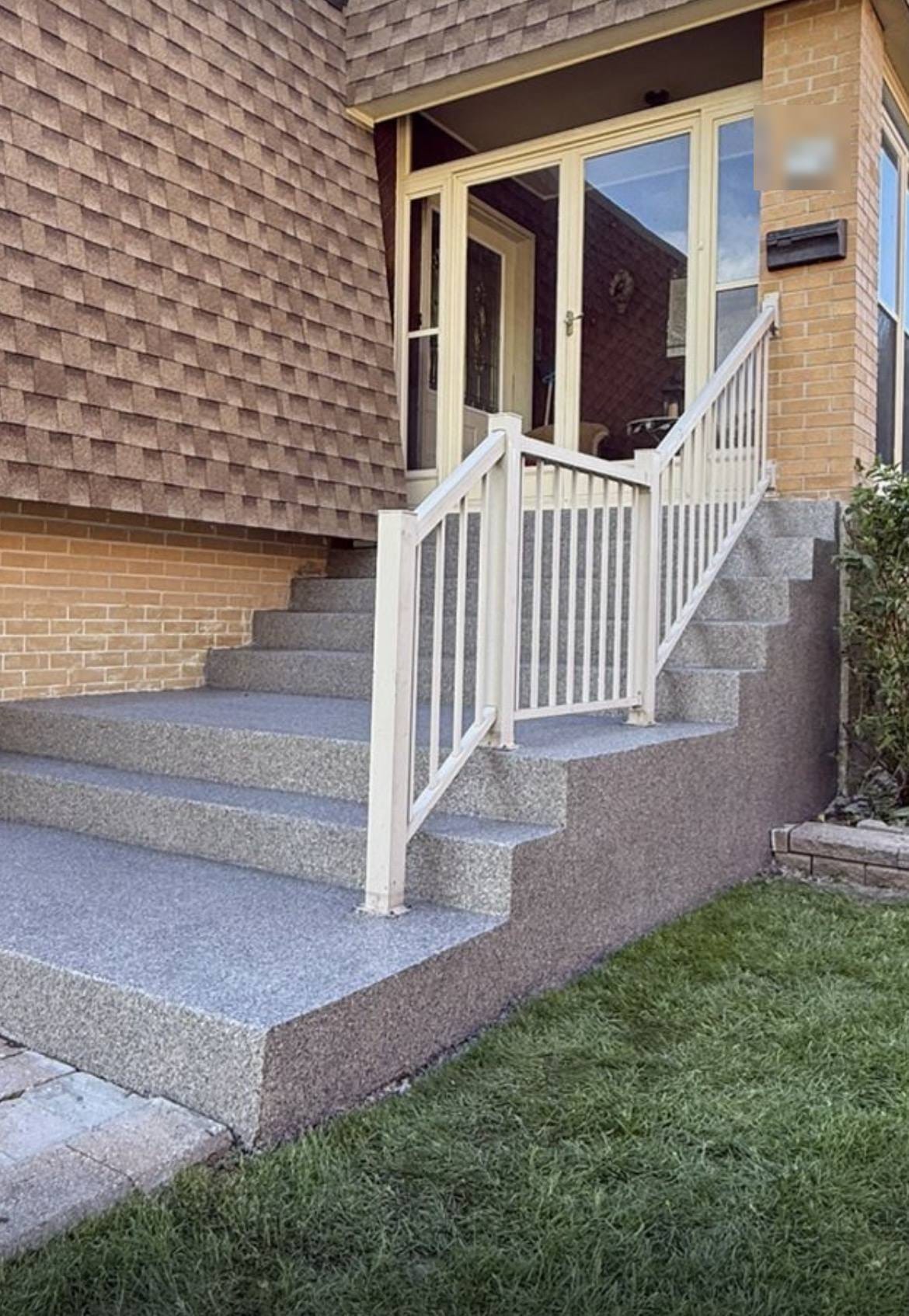
Once the concrete is repaired and rebuilt to profile, you have choices. Re-applying a cementitious overlay restores the stone look but re-enters the same failure cycle. Our usual recommendation, and what we installed on our documented Scarborough job, is a polyaspartic full-flake system: a bonded, flexible, UV-stable finish with real texture underfoot, built for exactly the salt and freeze-thaw that killed the overlay. It reads as granite rather than trowelled stone, and it does not delaminate in sheets when water tries.
The full job, removal, concrete repair and rebuild, and the complete flake system across treads, risers and side walls, is priced to the porch, its size and how much concrete has to be rebuilt, with smaller step-only projects costing far less. The complete photo record of one is on the site: what was failing, what came off, and what went on.
Key takeaways
- Jewel Stone is a decorative cementitious overlay, porous, rigid and bonded
- Water plus freeze-thaw delaminates it, starting at step edges
- A failing overlay cannot be coated over, new finishes bond to the loose layer
- Repair means full removal, then real concrete repair underneath
- A polyaspartic flake system replaces the failure mode, not just the look
- A full porch project is priced to its size, in a written itemized quote
Frequently asked
How do I know if my Jewel Stone is failing?
Hollow sounds when you tap it, hairline cracks that hold dirt, flakes lifting at step edges, and patches that look darker or damp. Once any area is delaminating, assume the water is travelling further than what you can see.
Can just the failed patches be fixed?
Spot repairs on a delaminating overlay rarely hold, because the failure is progressive, the patch bonds to overlay that is next in line to let go, and colour-matching aged Jewel Stone is close to impossible. Localized repair makes sense only when damage is genuinely isolated and the rest tests solid.
Is polyaspartic more durable than Jewel Stone?
They fail differently. A cementitious overlay is rigid and porous, so freeze-thaw delaminates it. A polyaspartic system is flexible, non-porous and UV-stable, so the sheet-delamination failure mode is designed out. No finish is maintenance-free, but one of them is built for this climate.
What does removing Jewel Stone involve?
Mechanical removal, grinding and chipping the overlay off back to the original concrete, then repairing what is underneath. It is dusty, labour-heavy work done with dust extraction, and it is most of the effort in the whole project.
 See it doneSC-01: the Jewel Stone porch, stripped and refinishedView →