
The short answer
In the epoxy vs polyaspartic garage floor choice, epoxy is the slower-curing, thick-building base with a long working time and strong chemical resistance, and polyaspartic is the fast-curing, UV-stable, more flexible coat that handles hot tires and cold installs better. Most well-built garage systems use both: an epoxy or polyurea base, a full flake broadcast and a polyaspartic top coat. In a Toronto garage that takes road salt all winter, grinding, slab repair and a moisture test decide how long either one lasts more than the chemistry does.
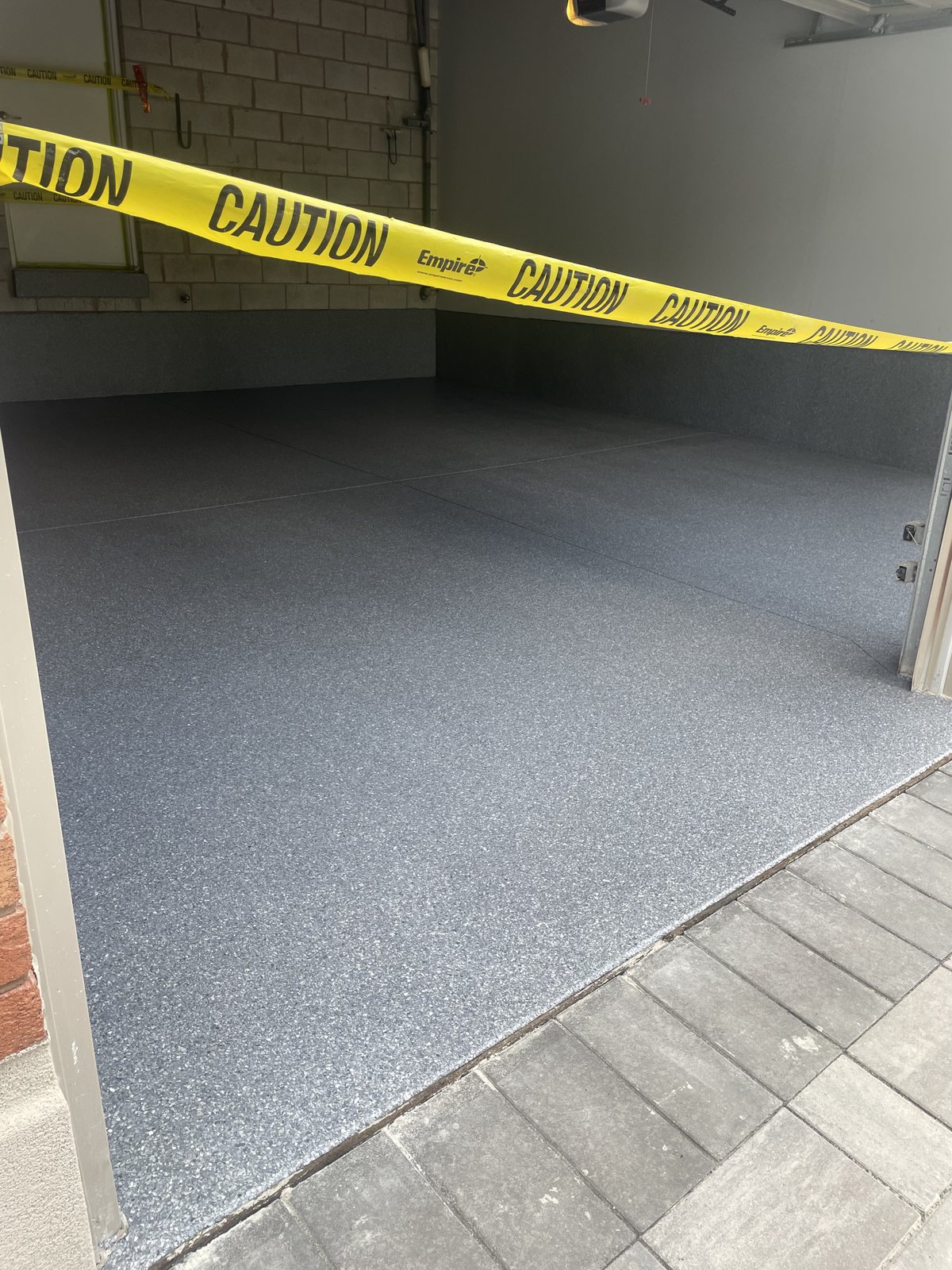
The two chemistries in plain terms
Epoxy is a two-part resin. A base and a hardener are mixed, and over the following hours they cross-link into a hard, rigid plastic that grips the concrete it was rolled onto. Floor epoxies range from thin water-based products to thick, 100 percent solids materials that build a substantial film in one coat. Their strengths are a long working time, a strong bond into ground concrete, good chemical and abrasion resistance, and the ability to fill and level small imperfections as they go down. Most floor epoxies are aromatic, which matters later: sunlight changes their colour.
Polyaspartic belongs to the polyurea family. An aspartic ester reacts with an aliphatic isocyanate, and the reaction is fast, often fast enough that a crew mixes small batches and works quickly to stay ahead of it. Because the chemistry is aliphatic, it holds its colour and gloss in ultraviolet light. It cures to a film that is tough and somewhat flexible, takes a second coat within hours, and many products are formulated to cure on a cold slab. The trade-off is a short pot life, thinner coats and less forgiveness for an inexperienced installer.
Epoxy vs polyaspartic garage floor: side by side
Neither chemistry wins every row. Epoxy is the better builder and the more forgiving material to install; polyaspartic is the better wearing surface for a garage door that opens onto sun, salt and January. The table sets out where each one leads, in general terms. The exact numbers for any product, its cure windows, temperature limits and film thickness, are on its technical data sheet, and a good quote follows them.
Swipe sideways to see every column →
| Property | Epoxy | Polyaspartic |
|---|---|---|
| Cure and return to service | Slower; usually one coat a day, with vehicles back after a longer cure | Fast; several coats in one day, foot traffic within hours, vehicles after a shorter cure |
| UV and yellowing | Most products amber and chalk in sunlight | Aliphatic; holds colour and gloss in sunlight |
| Hot-tire pickup | Thin and water-based products are prone; thick, well-bonded systems resist it better | Resists it well as a top coat |
| Flexibility and impact | Hard and rigid; strong in compression, can chip at edges | Tougher and more flexible; absorbs impact and slab movement better |
| Install temperature | Wants a warmer slab; cure slows sharply in the cold | Many products cure on a cold slab |
| Working time | Long; forgiving to roll and level | Short; small batches and an experienced crew |
| Film build per coat | Can be built thick in one coat | Usually applied thinner per coat |
| Odour and VOC | Solids epoxies are low odour; check the data sheet | Many contain solvent and smell strongly during the install; low-VOC versions exist |
| Cost position | Lower published range | Higher published range |
General behaviour of each chemistry. Individual products vary; the technical data sheet for the product quoted sets its limits.
Sun, hot tires and a door that opens onto winter
A garage floor is an interior floor with an exterior edge. With the door up, afternoon sun lands on the front third of the slab, and on a south- or west-facing garage that is enough ultraviolet to turn a clear aromatic epoxy amber and chalky over time. The film is still bonded and still protecting the concrete; it just looks tired. An aliphatic polyaspartic top coat does not do that, which is one of the main reasons it is used as the wearing surface even when the layers under it are epoxy.
Hot-tire pickup is the other garage-specific failure. A tire that has just come off the highway is hot, and the rubber carries plasticizers that migrate into a soft coating. The coating softens, bonds to the tread, and lifts when the car pulls away, leaving tire-shaped bald patches. Thin water-based epoxies and one-part floor paints are the usual victims. A thick, well-bonded epoxy resists it far better, and a polyaspartic top coat resists it best.
Flexibility and impact count too. Epoxy is hard and stiff, excellent under rolling loads and abrasion, but a dropped jack or a dragged tool on a sharp edge can chip it. Polyaspartic gives a little, so it takes a blow and tolerates the small thermal movement at the door, where the slab swings between a warm house and a cold driveway, with less cracking at the surface.
Cold slabs, odour and the install day
Most epoxies want a reasonably warm slab and air, and in a cold garage the cure slows to the point where the floor is soft for days. Many polyaspartics are formulated to cure on a much colder slab, which is why they are used to extend the install season in unheated Toronto garages in late fall and early spring. Whatever the chemistry, the slab temperature has to stay a few degrees above the dew point through the cure, or condensation forms on the surface and ruins the bond. The data sheet gives the limits, and a crew measures slab temperature and humidity on the day.
Odour is a fair question for an attached garage under a bedroom. Solids epoxies are low in odour. Many polyaspartics contain solvent and smell strongly while they are going down, though the smell clears quickly as the coating cures, and low-VOC formulations exist. Either way the house door stays closed, the garage is ventilated during the work, and the VOC content is listed on the product’s data sheet if you want to compare.
Why most garage systems use both
The common residential system plays each chemistry to its strength. The base coat is an epoxy, or in some systems a polyurea, chosen for bond and build: its working time lets it wet into the ground concrete and level small imperfections, and where the slab carries moisture the primer under it is usually a moisture-tolerant epoxy. Vinyl flake is broadcast into the wet base. The top coat is polyaspartic, chosen for wear, UV stability, hot tires and salt. The result is a floor with epoxy’s bond and polyaspartic’s surface, installed in a day or two.
All-polyaspartic systems, base and top, are common as well, mostly for the faster one-day turnaround and the cold-weather window. All-epoxy systems with an epoxy top coat still suit a workshop floor that rarely sees sun or a hot car, where chemical resistance and cost lead. The point is that each layer has a job, and a quote should say which product does which one.
Full flake or solid colour
A full flake broadcast means flake is thrown into the wet base until no more will stick, then the loose excess is scraped off and the floor is sealed with clear top coats. It adds thickness and texture, gives a car and a wet boot some grip, and hides the repair lines, pores and small level changes a ground slab always has. It also hides dust and salt residue between washes, which in a Toronto garage in February is a practical virtue.
A solid colour floor is two or more pigmented coats with no flake. It looks clean and uniform and costs less in materials, but it shows every patch, every tire mark and every grain of grit, and it is smoother, so it needs a fine aggregate in the top coat to keep it from being slick when wet. Partial flake sits in between. On an older, repaired garage slab, full flake is the more forgiving finish.
The slab matters more than the chemistry
In a garage that takes road salt, the coating’s chemistry decides how the surface wears. The slab underneath decides whether the coating stays on at all. Older Toronto garage slabs have often taken decades of salty slush bare, so they arrive pitted, scaled, oil-soaked or dusting, and some were poured without the air entrainment that protects concrete from salt and frost. Our posts on why garage floors flake and why coatings peel go into those failures in depth. Every one of them comes through any coating that is laid over it.
Diamond grinding is the preparation that matters most. It removes the weak top layer, old sealers and paint, and opens the concrete to the texture the coating maker specifies, usually described on the industry’s concrete surface profile scale. Pits, spalls and scaled patches are cut back and filled with a repair mortar that bonds, cracks are routed and filled, and any old coating is ground off completely.
Then moisture. A slab on grade can push water vapour up from below, and many older homes have no vapour barrier under the garage or basement slab. A taped plastic sheet left on the floor gives a rough first sign. The calcium chloride test, ASTM F1869, measures how much vapour leaves the top of the slab over a few days. In-situ relative humidity probes, ASTM F2170, measure the humidity inside the slab at a set depth. The result is compared with the limit on the coating’s data sheet, and where the slab is over it, a moisture-mitigating epoxy primer goes down first. Skip any of these steps and the choice between epoxy and polyaspartic stops mattering.
Cost drivers and how to read a quote
Published GTA ranges for installed garage coatings, before HST: epoxy systems $4 to $8 per square foot, polyaspartic or hybrid systems $6 to $12, and a moisture-mitigating primer $1.50 to $3 per square foot where the slab needs it. Inside those ranges the price moves with the work under the coating: grinding off a failed coating, the amount of crack and pitting repair, moisture mitigation, the number of coats and total film build, how densely the flake is broadcast, coated steps and stem walls, and the size of the floor, since a single small bay carries the same setup as a double. The sources are named on our cost page.
Two quotes for a coated garage floor are only comparable if they describe the same floor. Look for the layers by product type, base, flake, top coat and how many coats of each; the thickness of each coat or of the whole system, in mils or microns; the preparation method named as diamond grinding; the repairs listed as their own lines; whether a moisture test is included, which method, and what happens if the slab fails it; and the cure time before you park on it. A single price for an epoxy floor tells you almost nothing about any of those, and the gap between two quotes is usually hiding in them.
Key takeaways
- Epoxy builds thick, bonds well and is forgiving to install; polyaspartic cures fast, holds colour in sunlight and resists hot tires.
- Most good garage systems combine them: an epoxy or polyurea base, a full flake broadcast and a polyaspartic top coat.
- Full flake hides repairs and grit and adds grip; solid colour shows everything and needs aggregate to stay safe when wet.
- In a salted Toronto garage, grinding, slab repair and a moisture test decide how long any coating lasts.
- Published GTA ranges before HST: epoxy $4 to $8, polyaspartic or hybrid $6 to $12, moisture primer $1.50 to $3 per square foot.
- Compare quotes by layers, thickness, preparation, repairs, moisture testing and cure time.
Sources
The official and published sources this post relies on. Rules, fees and market prices change, so check the source before you plan around a figure.
- HomeStars: Understanding epoxy flooring cost, Canada source, as compiled on our cost page. Prices are quoted before HST.
- GLI Epoxy Flooring: Garage floor coating cost in Ontario, 2026, GTA source, as compiled on our cost page. Prices are quoted before HST.
- Coated.ca: Epoxy garage floor coating cost in Canada, 2026, Canada source, as compiled on our cost page. Prices are quoted before HST.
Frequently asked
Is one side of the epoxy vs polyaspartic garage floor question simply better?
No. Epoxy is the better base: it builds thick, wets into ground concrete and costs less. Polyaspartic is the better wearing surface: it cures fast, stays clear in sunlight and resists hot tires. That is why so many garage systems use an epoxy base under a polyaspartic top coat, and why the quality of the preparation under them matters more than the label on the pail.
Why has my epoxy garage floor turned yellow near the door?
Sunlight. Most floor epoxies are aromatic, and ultraviolet light through an open door ambers and dulls them, worst on the strip nearest the door. It is a surface change, and the film can still be well bonded. If it is, the floor can be abraded and finished with an aliphatic polyaspartic top coat that holds its colour.
Can a polyaspartic top coat go over my existing epoxy floor?
If the epoxy is sound and fully bonded, yes: it is cleaned, abraded to give the new coat something to grip, and top coated with a product the maker lists as compatible. If the epoxy is lifting, bubbling or peeling anywhere, it is ground off and the floor is prepared from bare concrete, because a new coat laid on a failing film comes away with it.
Can a garage floor be coated in November in Toronto?
Often, with the right product and conditions. Many polyaspartics cure on a cold slab where an epoxy would stall, and a garage can be closed up and warmed for the work. The slab still has to be dry, clean of salt, and a few degrees above the dew point through the cure, and those readings are taken on the day.
Is a coated garage floor slippery when it is wet?
A full flake floor has texture from the flake itself and is far less slick than a smooth solid colour. A solid colour floor needs a fine anti-slip aggregate mixed into or broadcast on the top coat. Either way, the level of texture is a choice made before the top coat goes down, so it is worth asking for on any quote.
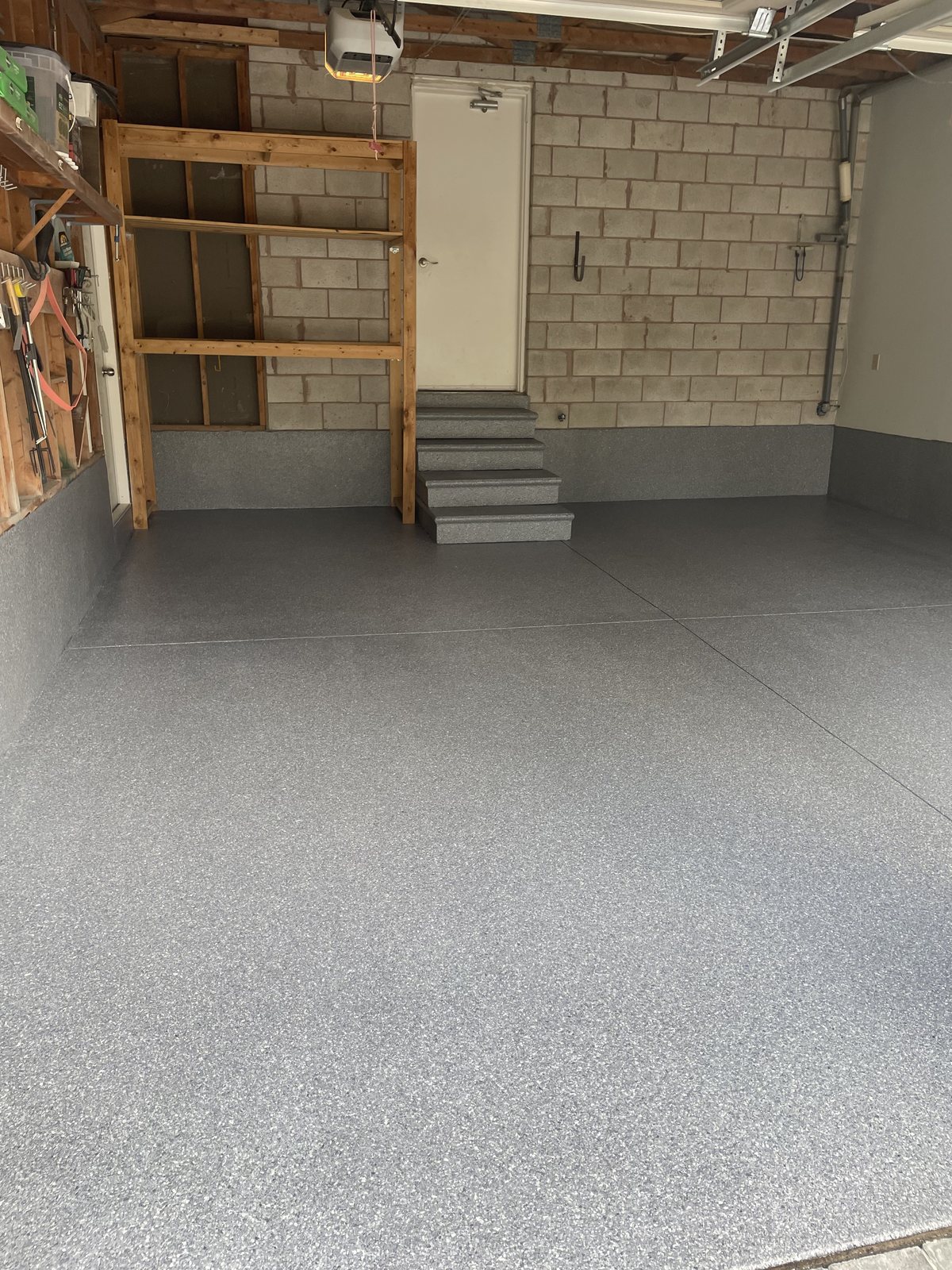 See it doneA two-car garage, slab prepared and repaired, then a base coat, full flake broadcast and a sealed top coatView →