
The short answer
Coatings peel for five reasons: moisture coming up through the slab, a surface that was never mechanically prepared, a product that was wrong for the exposure, contamination such as oil, sealer or curing compound left in the concrete, and a slab that is itself scaling or delaminating under the coating. The fix is to find which one, strip the failed coating, correct the cause and recoat. Published GTA installed ranges, before HST, are $4 to $8 per square foot for epoxy and $6 to $12 for polyaspartic, with a moisture-mitigating primer adding $1.50 to $3 where the slab needs it.
Moisture coming up from below
A slab on the ground is a sponge with a dry top. Water vapour moves up through it constantly, and in a Toronto basement or garage the slab can be carrying far more moisture than it looks like. Put an impermeable coating over it and the vapour has nowhere to go; pressure builds under the film, and the coating blisters, bubbles and lifts, often with a white mineral residue underneath. This is the most common reason basement floor coatings fail and a frequent one in garages, and it is entirely predictable with a moisture test before anyone opens a pail. Where the test says so, the fix is a moisture-mitigating primer or a system designed to breathe, and where it says the slab is too wet for any coating, the right answer is polishing or a different floor.
Preparation that was not preparation
A coating bonds to concrete mechanically, by keying into an open, textured surface. Acid etching, the method on the back of the hardware-store kit, does not reliably produce that profile and leaves salts behind; a pressure wash produces nothing at all. Floors that peel in clean sheets with sound concrete underneath were almost always coated over a surface that was never ground or shot-blasted. Diamond grinding opens the surface, removes the weak laitance on top of the slab and takes off whatever was there before, and it is the line most often missing from a cheap coating quote.
The wrong product for the exposure
Thin water-based epoxies soften under a hot tire and lift when the car pulls away, which is the tire-shaped bald patch in so many garages. Standard epoxies yellow and chalk in sunlight, so on an exterior porch or walkout they fail at the surface within a few seasons. Products with no slip aggregate on a stair in the rain are a different kind of failure. Garages, porches and exterior steps want a system built for them: a bonding base, a full flake broadcast, and a polyaspartic or polyurethane top coat that takes heat, salt and UV. Using the right chemistry for where the floor lives is not an upgrade, it is the minimum.
Contamination you cannot see
Oil that has soaked into a garage slab for years, a silicone or acrylic sealer somebody applied a decade ago, the curing compound sprayed on the day the slab was poured, old tile adhesive, even the residue of a previous failed coating: any of them sits between the concrete and the new film and the coating bonds to that instead of to the slab. Grinding removes most of it; stubborn oil and adhesive need specific removal before the floor is coatable, and a quick test patch tells the truth before the whole floor is committed.
When it is the slab, not the coating
Sometimes the coating is attached perfectly well, to a layer of concrete that is leaving. Salt scaling and delamination under a coating lift the film with the surface, and the flakes you pick up have concrete stuck to the back of them. No coating survives that, because the failure is in the slab. The surface has to be ground back to sound concrete, the pits and spalls repaired and, where the damage covers most of the floor, the slab resurfaced before it is coated again.
What the fix costs, in published GTA ranges
Stripping a failed coating is grinding, priced to the floor by its area and by how stubborn the old film is. The recoat then sits in the published GTA ranges: $4 to $8 per square foot installed for epoxy and $6 to $12 for polyaspartic or hybrid systems, with a double garage in a full flake system at $2,800 to $4,500, a moisture-mitigating primer adding $1.50 to $3 per square foot where the test calls for it, and basement floors at $5 to $9 per square foot with removal of existing flooring adding $2 to $4. Repairs to a scaled or delaminated slab before the coating are priced on the repair area, at $7 to $15 per square foot. All before HST, all market ranges compiled from published Canadian sources so you can sanity-check any quote, including ours; the sources are on our cost page.
Key takeaways
- Moisture, preparation, product, contamination or the slab: a peeling coating is one of those five, and the fix starts with which.
- Test the moisture before anyone opens a pail; where the slab is too wet, coat something else or polish it.
- Diamond grinding is the preparation; acid etching and pressure washing are not.
- Garages and exterior concrete want a flake system with a polyaspartic or polyurethane top coat, not a thin epoxy.
- Published GTA recoat ranges before HST: epoxy $4 to $8, polyaspartic $6 to $12, moisture primer $1.50 to $3 per square foot.
Sources
The official and published sources this post relies on. Rules, fees and market prices change, so check the source before you plan around a figure.
- GLI Epoxy Flooring: Garage floor coating cost in Ontario, 2026, GTA source, as compiled on our cost page. Prices are quoted before HST.
- Coated.ca: Epoxy garage floor coating cost in Canada, 2026, Canada source, as compiled on our cost page. Prices are quoted before HST.
- HomeStars: Understanding epoxy flooring cost, Canada source, as compiled on our cost page. Prices are quoted before HST.
- GLI Epoxy Flooring: Epoxy basement flooring Toronto, 2026 cost and guide, GTA source, as compiled on our cost page. Prices are quoted before HST.
Frequently asked
Can I recoat over a peeling coating?
No. Whatever made the first coating fail is still there, and the new one bonds to the old film rather than to the slab. The failed coating is ground off, the cause is corrected and the floor is coated as if for the first time.
Why did my coating peel only where the tires sit?
Hot tire pickup. A thin or soft coating softens under the heat of a tire that has just come off the highway and comes away when the car moves. A properly prepared slab with a polyaspartic or polyurethane top coat does not do it.
Will a new coating peel too?
Not if the cause was found and corrected. A coating over a tested, repaired and mechanically prepared slab, in a system built for the exposure, is a long-lived floor. A coating put straight back over the same conditions fails the same way.
The epoxy in my basement bubbled and peeled. What now?
Almost certainly moisture from below. Have the slab tested; the result decides between a moisture-mitigating primer under a new system, a breathable finish, or polishing the concrete instead of coating it. Our basement floor coating page goes through the options.
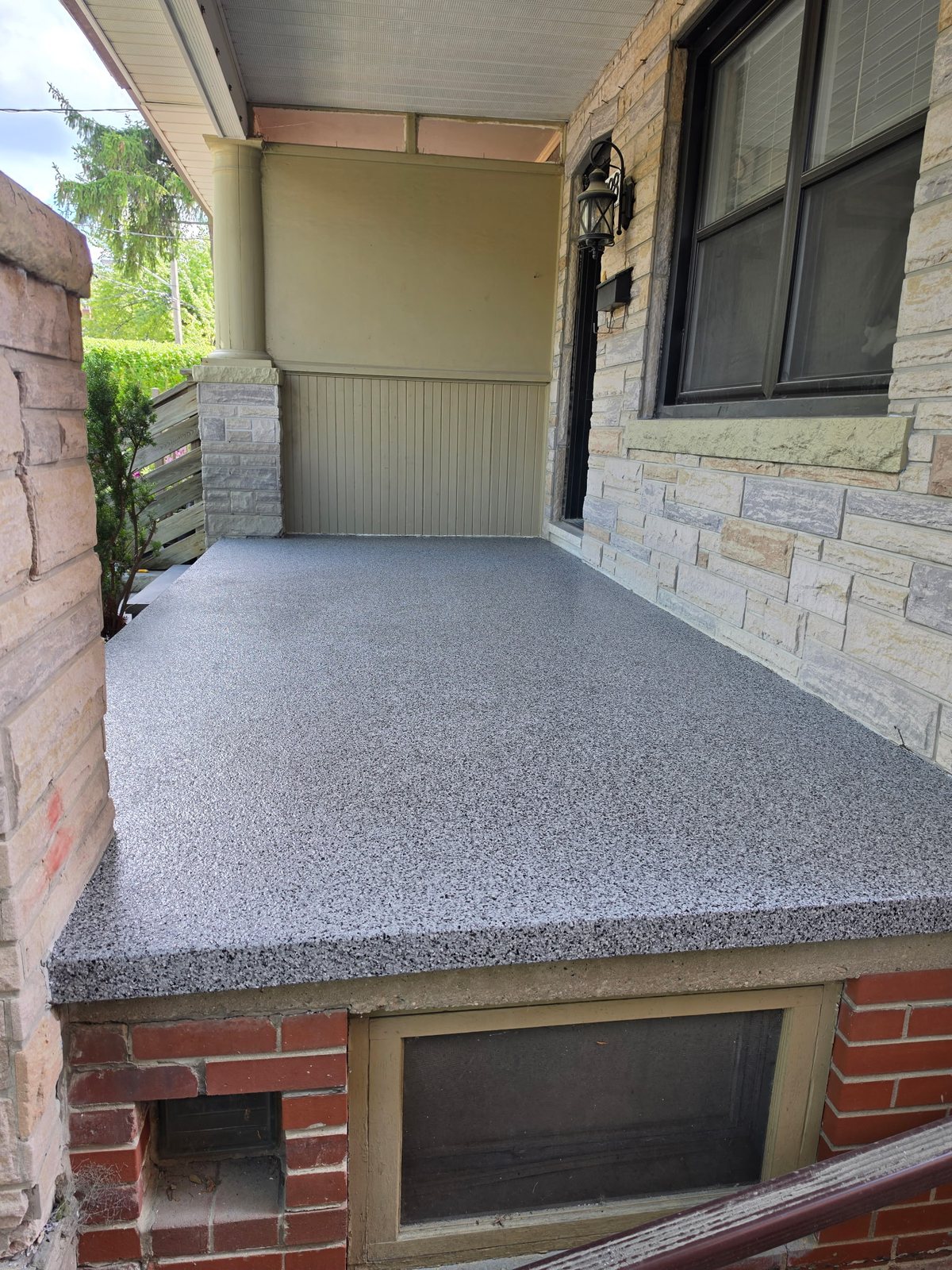 See it doneA covered Toronto porch finished in a full-flake coating over prepared concreteView →