
The short answer
Garage floors flake because salt-laden slush drips off the car, soaks into the surface and freezes; the ice expands and pops the top layer off, a little every winter. Slabs that were finished too early, overworked or poured without air entrainment scale fastest. The repair depends on depth: light scaling is ground and coated, heavy pitting is resurfaced, and a slab that is delaminating or cracked through is rebuilt. Published GTA ranges, before HST: spalling and scaling repair $7 to $15 per square foot of repair area, resurfacing $3 to $10, polyaspartic coatings $6 to $12.
What flaking actually is
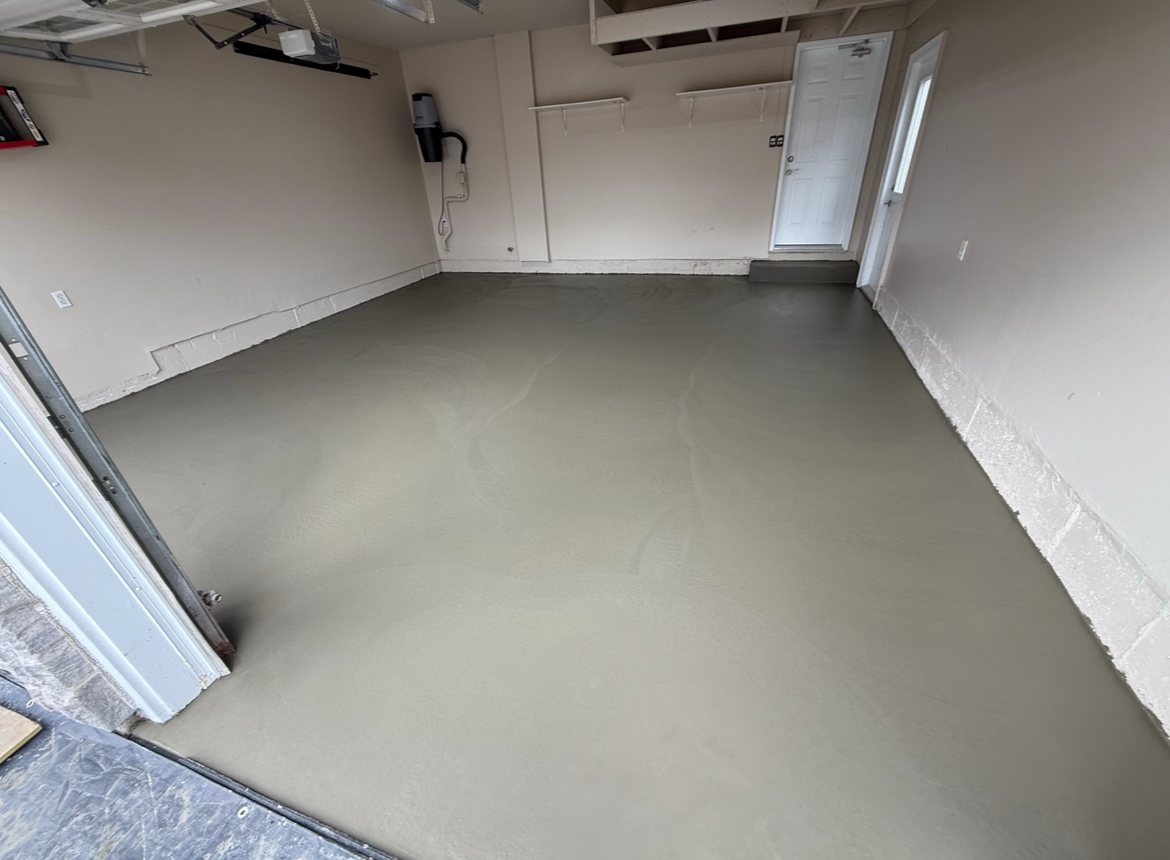
Concrete finishers call it scaling: the loss of the thin, cement-rich surface layer in flakes and patches, leaving the sand and stone underneath exposed and rough. It usually starts as a few coin-sized flakes in the spots where the car drips, spreads into pitted patches, and on a bad slab ends with the whole top centimetre gone. Spalling is its bigger cousin, deeper losses often driven by rusting steel; delamination is when a whole layer separates and sounds hollow before it breaks away. Dusting, a floor that sheds grey powder, is a weak surface wearing away rather than freezing off. They overlap, and the repair is chosen by depth rather than by name.
Why Toronto garages get it worse
A parked car in January is a salt dispenser. Slush loaded with road de-icer drips off the wheel wells and the underbody into the same few spots every day, soaks into the surface, and freezes overnight when the door has been open. Water expands when it turns to ice, and in the pores of the top layer that expansion pries the surface apart from inside. The salt makes it worse twice over: it draws more water into the concrete and it concentrates as the water evaporates, so the surface goes through more freeze and thaw cycles, with more salt in them, than any other concrete on the property. An unsealed, uncoated garage floor in this climate is scaling on a schedule.
The part that was decided on pour day
Two garage floors poured the same year can be in very different shape, and the difference is usually how they were finished and what was in the mix. A slab trowelled while bleed water was still on the surface, or overworked to a glassy finish, has a weak, dense skin that scales early. A slab cured badly, left to dry out in a hot week, never reaches its strength at the surface. And a slab poured without air entrainment, the microscopic air bubbles that give freezing water somewhere to expand, has no defence against the salt and frost cycle at all. The Canadian concrete standard treats salted exterior flatwork as its own exposure class, with a minimum strength, a maximum water content and a required range of entrained air, precisely because this is the failure it prevents. Older garage floors and cheaper pours often had none of it.
What is repairable, by depth
Light scaling on a sound slab: the floor is diamond-ground back to solid concrete, the few deeper pits are filled with a bonded repair mortar, and the floor is coated or sealed so the salt stops reaching it. Heavy pitting across most of the floor: grinding and patching dozens of pits is slower and uglier than resurfacing, so the slab is ground to sound material and given a new face with a cementitious or polymer resurfacer, then coated if you want it. Delamination or a slab cracked into moving pieces: the failed layer or section is removed and rebuilt, or the slab is replaced, because nothing bonded to a surface that is leaving survives. Which depth you have is a ten-minute check with a hammer and a straightedge, and it is done before anything is priced.
What it costs, in published GTA ranges
Spalling and scaling repair across the GTA runs $7 to $15 per square foot of repair area, priced on the area that actually needs work with a small-job floor of $500 to $1,200. Resurfacing is $3 to $10 per square foot basic. Installed coatings are $4 to $8 per square foot for epoxy and $6 to $12 for polyaspartic systems, with a double garage in a full flake finish at $2,800 to $4,500. All before HST, all market ranges compiled from published Canadian sources so you can sanity-check any quote, including ours; the sources are named on our cost page.
Stopping it coming back
A repaired floor flakes again if the salt keeps reaching it. A flake coating with a polyaspartic top coat keeps the water and salt off the concrete entirely; a penetrating sealer slows absorption on a floor you do not want to coat. Either way, rinse the salt off the floor through the winter, use a mat under the drip zone and do not let slush sit in the same spot for weeks. The floor that was finished badly on pour day cannot be re-poured, but it can be protected from the thing that is taking it apart.
Key takeaways
- Flaking is the top of the slab freezing off; salt-laden slush from the car starts it and freeze-thaw drives it.
- Early finishing, overworking, poor curing and no air entrainment decide how fast a slab scales.
- Depth decides the repair: grind and coat, resurface, or rebuild.
- Published GTA ranges before HST: scaling repair $7 to $15 per square foot of repair area, resurfacing $3 to $10, polyaspartic $6 to $12.
- Coat or seal the repaired floor and rinse the salt off it, or the cycle restarts next winter.
Sources
The official and published sources this post relies on. Rules, fees and market prices change, so check the source before you plan around a figure.
- HomeStars: Understanding concrete contractor cost in Toronto, Canada source, as compiled on our cost page. Prices are quoted before HST.
- The Art of Concrete: Concrete repair cost in Ontario, what to expect, Ontario source, as compiled on our cost page. Prices are quoted before HST.
- Artisan Coat: How much does concrete resurfacing cost in Toronto, 2026, GTA source, as compiled on our cost page. Prices are quoted before HST.
- GLI Epoxy Flooring: Garage floor coating cost in Ontario, 2026, GTA source, as compiled on our cost page. Prices are quoted before HST.
Frequently asked
Is a flaking garage floor a structural problem?
Usually not. Scaling is a surface failure, the loss of the top layer, and the slab under it is typically sound. It becomes structural when the losses deepen into spalling that exposes reinforcing steel, or when the slab is delaminating or cracking through, which is why the depth is checked before anything is quoted.
Can I patch the flaking spots myself?
Hardware-store patch over an unprepared, salt-contaminated surface comes off with the next winter, usually taking a little more concrete with it. A lasting repair grinds back to sound concrete, uses a repair mortar that bonds, and protects the surface afterward.
Will sealing the floor stop the flaking?
On a floor that has only just started, a penetrating sealer slows the water and salt getting in and slows the scaling. On a floor that is already pitted it seals the damage in place. Repair first, then protect, with a sealer or a coating depending on what you want the floor to look like.
Should I just coat over the flaking floor?
Not until the loose and pitted surface has been ground off and repaired. A coating bonded to a layer that is still coming off comes off with it, and the flakes you pick up afterward have concrete on the back. Our post on why coatings peel covers exactly that failure.
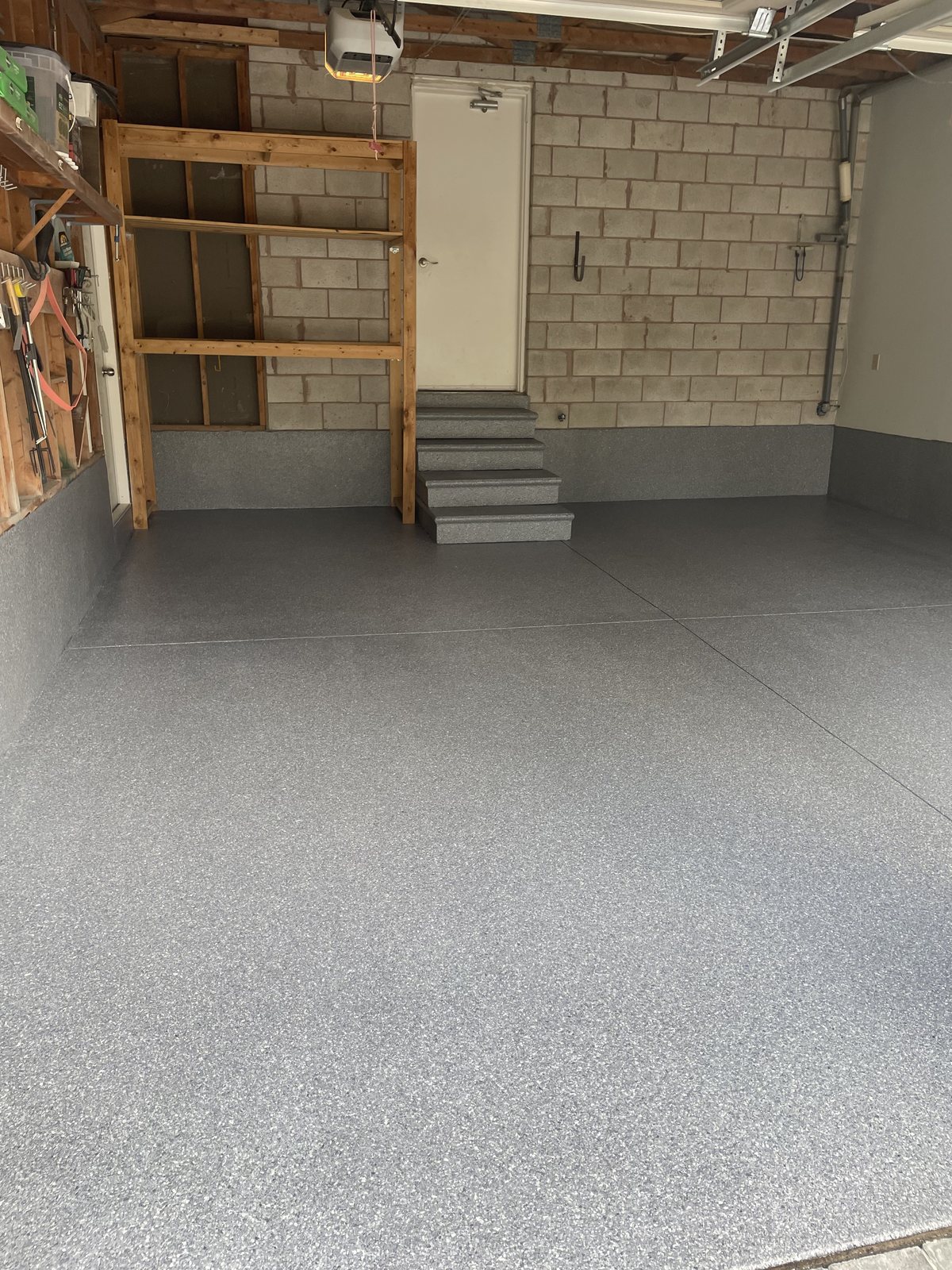 See it doneA two-car garage, slab repaired first, then finished in a full-flake system that keeps the salt off itView →