
The short answer
Repairing concrete steps in Toronto runs from the $500 to $1,200 small-job floor for a single nosing or spall, to $1,000 to $2,500 to rebuild the edges along a whole flight, to $2,000 to $4,800 to resurface a typical three-to-five-step entrance, all before HST. When the stair itself has failed, demolition and re-pour of a standard front entrance is published at $4,500 to $8,000 in Toronto, three to five poured steps are $2,500 to $6,000 in Kitchener-Waterloo, and precast units run $100 to $350 per step plus $500 to $1,500 to remove the old ones. Riser count is the multiplier, the first step carries the setup, and no reliable Canadian per-step figure exists for poured front steps.
What a step costs depends on which part of it failed
A concrete step is three surfaces and an edge: the tread you stand on, the riser you see, the side face, and the nosing where the tread meets the riser, which is the part that breaks first because it takes the toe of every boot and the edge of every shovel. Behind those surfaces is a mass of concrete that is either still one solid piece or is not, and that single fact divides every stair repair into two families with two very different prices. The table below is every published Canadian figure we could find for steps, before HST, arranged from the smallest repair to the full replacement. The companion guide to the whole porch, slab and walls included, is linked at the end.
Swipe sideways to see every column →
| What the step is doing | Published range | Unit | What it covers |
|---|---|---|---|
| One chipped nosing or a small spall | $500 – $1,200 | per visit | The small-job floor: the visit costs the same for one edge or four, so bundle the borderline ones. |
| Nosings and edges rebuilt along the flight | $1,000 – $2,500 | per flight | Section work on a sound stair, with a flake or broom-textured wearing surface over it. |
| A corner broken out of a tread | $300 – $900 | per corner | Published as an add-on inside a resurfacing scope. |
| Whole flight resurfaced, three to five steps and a landing | $2,000 – $4,800 | per project | A plain overlay from about $1,800; a stone-look decorative overlay $2,400 – $4,800. |
| Stair cracked through, settled or pulled from the house | $4,500 – $8,000 | per project, Toronto | Demolition and re-pour of a standard front entrance: removal, base, insulation, steel, forms, one pour; five to ten days with cure. |
| The same re-pour by riser count, outside the GTA | $2,500 – $6,000 for 3 to 5; $10,000 – $14,000 for 8 to 14 | per set, Kitchener-Waterloo | The cleanest published example of riser count as the multiplier. |
| Replace with precast units | $100 – $350 | per step | $500 – $3,500 per typical project, plus $500 – $1,500 to remove the old steps; a builder step unit retails at $95 – $135. |
| Stair replacement, a buyer’s guide range | $2,500 – $10,000 | per stair | A Toronto buyer’s guide that covers wood as well as concrete stairs. |
Market ranges from the Canadian sources listed at the end. Our estimate is itemized by location on your stair after a free on-site assessment. Add 13% HST to every figure.
The first step costs the most: how the floor works
The number people find hardest to accept is the one for a single nosing. One broken edge, an hour of skilled work, and the published Ontario range for it is $500 to $1,200. That is not the cost of the nosing; it is the cost of the visit. Two people, a truck, the mixing, the forms for the profile, the cleanup and a return to check the cure are the same whether one edge is rebuilt or four, and labour is 70 to 80 percent of a repair bill in a city where the Government of Canada Job Bank puts the median concrete finisher at $43.58 an hour, above the Ontario high end.
Run the arithmetic the other way and the picture flips. A flight of four with every nosing rebuilt sits in the published $1,000 to $2,500 band for section work. Spread across four steps, that is $250 to $625 a step, and the fourth step on the visit costs a fraction of the first. That is our own arithmetic on a published range, not a published per-step rate, and it is the reason we tell people with one bad step to let us look at the other three while we are standing there. The borderline ones are cheapest to fix on the day the setup is already paid for.
Nosings, treads and risers: the repairs and what they run
A nosing rebuild cuts the broken edge back to sound concrete, forms the profile and rebuilds it in a bonded repair mortar that is stronger than the original and keyed in so it does not pop off with the first frost. On its own it is a level-one job at the floor; along a flight it is section work. A scaled tread, where salt and freeze-thaw have taken the top layer off, is ground back to solid concrete and given a new wearing surface; one tread is a small repair, every tread is a resurfacing. Riser faces that have spalled are rebuilt the same way as nosings and usually come along for the ride. Cracks are read before they are priced: a tight crack that does not move between seasons is filled and finished over, and a crack that opens and closes, or that has an offset across it, is telling you the stair is moving, which is a different family of repair.
The test that sorts them is the hammer. A tread that rings solid under a tap is a surface repair however bad it looks. A tread that sounds hollow has delaminated, and a hollow tread next to a tread worn into a dish is a stair that has lost its shape rather than its skin. That is the line between the top half of the table and the bottom half, and it is why we will not price a stair from a photograph.
Corners, side walls and the landing
A corner broken clean out of a tread is the most common structural repair inside an otherwise cosmetic job, and a Toronto resurfacing guide prices it as an add-on at $300 to $900 per corner, which is about right for the forming and the bonded rebuild it takes. Side walls, the cheek walls that flank many Toronto stairs, spall on their faces and caps the same way treads do and are repaired the same way, as long as they are plumb and still attached. A side wall leaning outward, or a gap opening where the top step meets the house, is not a surface problem. The ground under the stair has moved, and the price for that is in the next section, not this one.
When the stair itself is the problem: re-pour or precast
Treads worn hollow, the mass cracked through, a stair that has settled, tilted or pulled away from the foundation, risers that have become uneven because one end sank: that stair comes out. Demolition and re-pour of a standard front entrance is published at $4,500 to $8,000 in Toronto, five to ten days including the cure. What that buys is mostly underground: the old stair broken out and hauled away, the ground excavated and rebuilt in compacted clear stone, rigid insulation so frost cannot get under the new stair, a tied rebar mat held up into the section where it carries load, forms built to a consistent rise and run, and the stair and landing poured as one piece so there is no cold joint to open later.
Riser count is the multiplier, and the clearest published proof is a Kitchener-Waterloo contractor’s price page: three to five poured steps at $2,500 to $6,000, eight to fourteen at $10,000 to $14,000. Every added riser is more forming, more steel and more concrete. Those figures sit below Toronto’s because labour sits lower there, and removal, disposal and access on a narrow city lot all cost more here as well.
Precast is the other honest route for a straight, simple run. Units made off site are set on a prepared base in a day, published at $100 to $350 per step installed, or $500 to $3,500 for a typical project, plus $500 to $1,500 to remove the old steps; a plain builder step unit retails at about $95 to $135 before delivery and setting. The base is still the job. Precast set on the fill that let the old stair sink will sink the same way, which is why the cheap precast quote and the good one differ in what is under the units, not in the units.
Railings, guards and the lines people forget
Railings come out and go back in on almost every stair repair and that is routine, but new steel, welding or re-anchoring posts into rebuilt concrete is its own visible line and should appear as one. A rebuilt stair is built to the Ontario Building Code’s stair geometry and guard requirements, which can mean a guard where there was only a railing before. Disposal is a real line on a re-pour, a walk-up on a narrow lot costs more to strip and haul than a stair beside a driveway, and exterior concrete has a season in Toronto: a stair that fails in January is assessed in winter and rebuilt when the ground allows, because cold-weather concrete needs protection and costs more.
Reading a steps quote by riser
Ask for the estimate by location: this nosing, these two treads, this corner, the landing. A quote that lists a stair as one line cannot be compared with one that lists it by step, and the by-step version is the one that lets you add or drop the borderline repairs. Treat any per-step price for poured steps with suspicion, because the per-step figures in circulation are American calculator numbers that have never met a Toronto frost line. And remember the rule that costs people the most: the cheapest quote on a failing stair is almost always a coating, and you pay for the coating and then for the rebuild.
HST, and the number we will not publish
Every figure here is before HST, and Ontario adds 13 percent on top. We do not publish a per-step price for poured front steps because every one we could find is United States data, and the Ontario per-step figures that do exist are for precast units and simple landscape steps, which is how the table above labels them. A poured Toronto stair on a frost-protected base is priced to the structure: riser count, base depth, removal, railings and access, in writing, after someone has tapped it.
Two Toronto stairs, two answers
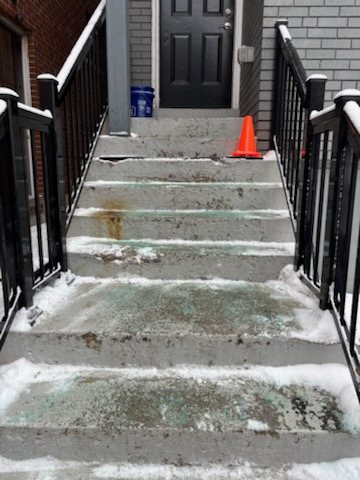
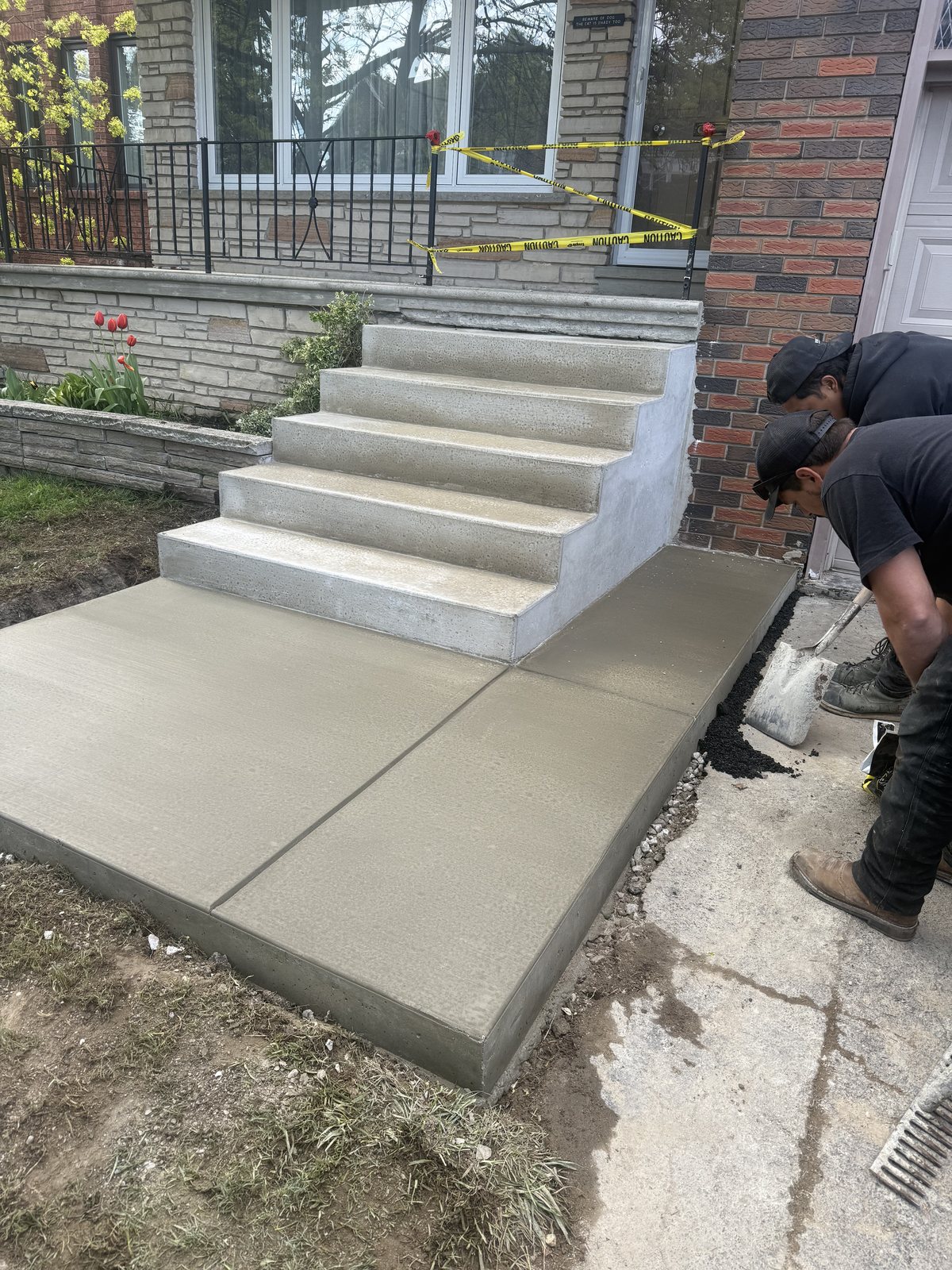
The salt-damaged front steps at the top of this page had spalled treads and broken nosings on every step, and a structure that was level, tight to the house and solid under the hammer. They were stripped, rebuilt to profile and finished in a granite-look flake system with the railings out and back in: section work and resurfacing, the top half of the table. The steps in the proof card below had treads worn hollow and nosings gone entirely, and the stair had stopped being a solid object. They were broken out, the ground excavated and rebuilt on compacted clear stone with insulation and a tied rebar mat, and stair and landing poured as one piece: the bottom half of the table. We do not publish either invoice, because your stair is neither of these, but both records are published in full so you can see what each family of work actually involves.
Key takeaways
- One nosing or spall sits at the $500 to $1,200 floor because the visit costs the same for one edge or four; bundle the borderline steps.
- Edges rebuilt along a whole flight run $1,000 to $2,500; resurfacing a three-to-five-step entrance $2,000 to $4,800; corners $300 to $900 each.
- A stair that is hollow, cracked through or settled comes out: $4,500 to $8,000 to re-pour a standard entrance in Toronto, with riser count as the multiplier.
- Precast units run $100 to $350 per step plus $500 to $1,500 removal; the base under them is still the job.
- No reliable Canadian per-step figure exists for poured front steps; per-step prices online are American.
- All figures before HST; ask for the estimate by location on the stair.
Sources
The official and published sources this post relies on. Rules, fees and market prices change, so check the source before you plan around a figure.
- The Art of Concrete: Concrete repair cost in Ontario, what to expect, Ontario source, as compiled on our cost page. Prices are quoted before HST.
- The Art of Concrete: How much does it cost to repair concrete steps, sidewalks, driveways and patios in Ontario, Ontario source, as compiled on our cost page. Prices are quoted before HST.
- The Art of Concrete: Concrete porch and step pricing, Kitchener-Waterloo, Cambridge and Guelph, Ontario source, as compiled on our cost page. Prices are quoted before HST.
- Artisan Coat: Concrete steps resurfacing in Toronto: 2026 costs, finishes and what to expect, GTA source, as compiled on our cost page. Prices are quoted before HST.
- Project Landscaping: Cost of outdoor stone and precast steps in Ontario, 2026, Ontario source, as compiled on our cost page. Prices are quoted before HST.
- Toemar Garden Supplies: Pre-cast concrete builder steps, retail unit price, Ontario source, as compiled on our cost page. Prices are quoted before HST.
- Smart Buyer Guide: Porch renovation cost Toronto: repair vs rebuild guide, GTA source, as compiled on our cost page. Prices are quoted before HST.
- Government of Canada Job Bank: Concrete finisher wages, Toronto region, Institutional source, as compiled on our cost page. Prices are quoted before HST.
Frequently asked
How much does it cost to fix one concrete step?
A single nosing or spall on a sound step sits at the published Ontario small-job floor of $500 to $1,200 before HST, because the visit, the forms and the cleanup cost the same as they would for four. If other steps are borderline, having them done on the same visit is the cheapest they will ever be.
How much does it cost to replace concrete front steps in Toronto?
Demolition and re-pour of a standard front entrance is published at $4,500 to $8,000 in Toronto, before HST, over five to ten days including cure. Outside the GTA the same work is published at $2,500 to $6,000 for three to five steps and $10,000 to $14,000 for eight to fourteen, which shows how the number scales with riser count. Precast units run $100 to $350 per step plus $500 to $1,500 to remove the old steps.
Are precast steps cheaper than poured?
Usually, for a straight and simple run, because the units are made off site and set in a day. They are not cheaper if the base is skipped: precast set on uncompacted fill sinks like the stair it replaced. Poured is the answer for wide entrances, landings and anything that has to tie into a porch.
Can a broken corner on a concrete step be repaired?
Yes. A corner broken out of a tread is formed and rebuilt in a bonded repair mortar keyed into sound concrete, and a Toronto guide prices it at $300 to $900 per corner as an add-on inside a resurfacing scope. It becomes a different job only if the step under the corner is hollow or the stair is moving.
Why is there no per-step price for concrete steps?
Because every per-step figure for poured front steps that exists is United States data, and converting one and calling it a Toronto price would be guessing. The Ontario per-step figures that do exist are for precast units and simple garden steps, and we publish those labelled as exactly that. A poured stair is priced to the structure, by riser count, base, removal and access.
Do you repair basement walkout and side steps too?
Yes. Walkout stairwells fail from the drain up, so the stair, the side walls and the landing drain are scoped together; the repairs themselves price the same way as a front stair. Our walkout page sets out how that work runs.
 See it doneThe documented Toronto step replacement, from excavation to the pourView →