
The short answer
Resurfacing works when the slab is structurally sound, not moving, and clean and dry enough to bond to: an overlay replaces the face, not the structure. Replacement is the better answer when the slab is cracked through and moving, has settled or heaved, has lost its base, or is too thin to carry an overlay. Published GTA ranges, before HST: resurfacing $3 to $10 per square foot basic and $7 to $12 decorative, with projects mostly $2,500 to $18,000 and typically 40 to 60 percent below tear-out; driveway replacement including removal $12 to $20 per square foot, or $8,000 to $15,000 for a standard driveway.
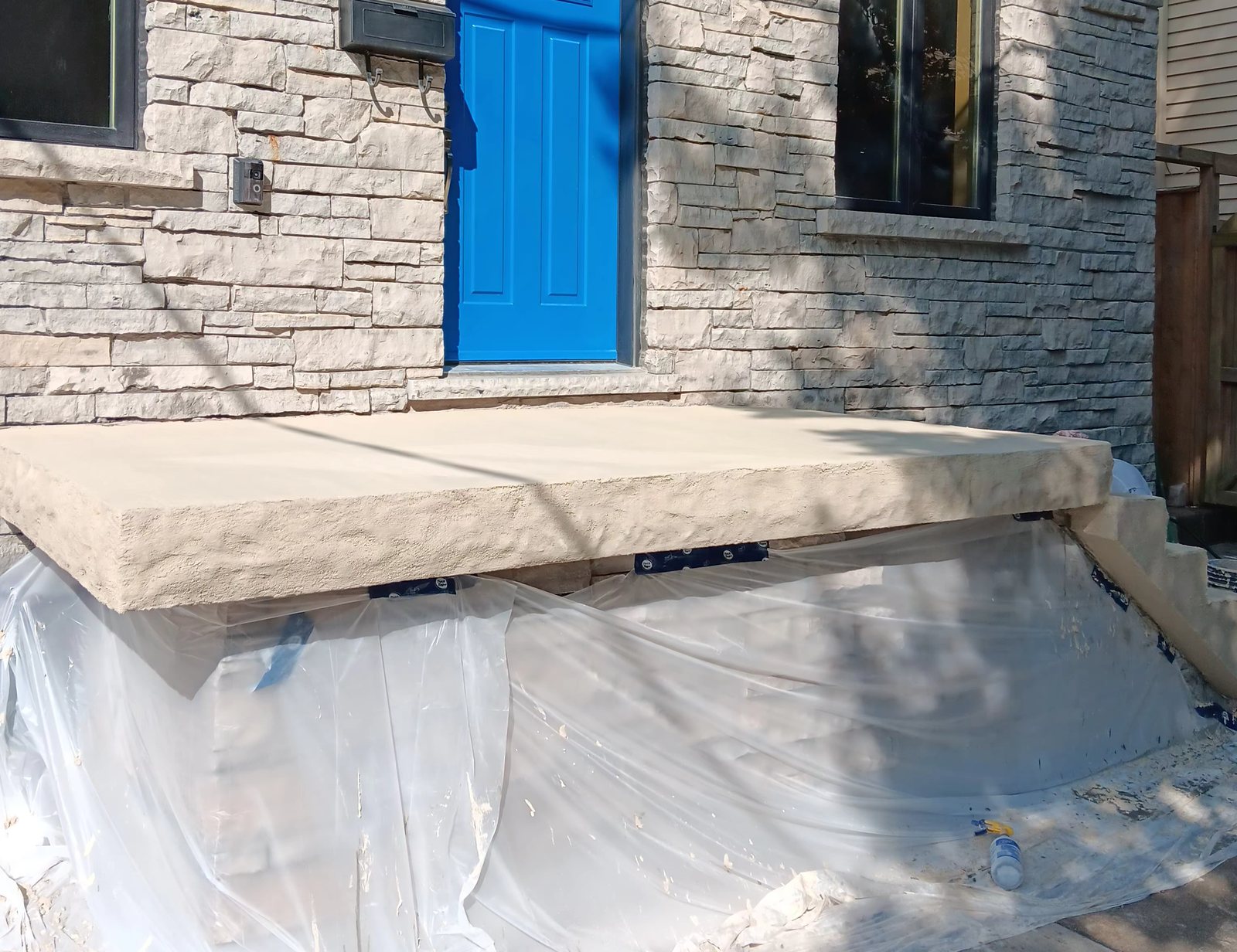
What an overlay can and cannot do
A resurfacing overlay is a thin layer of cementitious or polymer-modified material bonded to the top of an existing slab. It gives the slab a new wearing surface, a new texture and, if you want it, a new colour or a stamped pattern, over concrete that is still doing its job. It fixes scaling, pitting, surface spalling, staining and an ugly old finish. It is a face, and a good one.
What it cannot do is hold a slab together. An overlay does not stop movement, bridge a crack that opens and closes with the seasons, lift a settled corner or replace a base that has washed away. Put one over a slab that is moving and the slab moves under it; the overlay cracks along the same lines within a year or two and now you have the original problem plus a failed overlay to remove. Every honest resurfacing decision comes down to whether the slab underneath is sound.
Four tests before anyone quotes an overlay
Sounding. The slab is tapped across its area with a hammer or a chain; a hollow drum means the surface has delaminated and that area has to come out and be rebuilt before anything is bonded to it. Cracks. Each crack is checked for width, for an offset between the two sides and for whether it is moving; a tight, dormant crack is filled and overlaid, a working crack is sealed flexibly and honoured as a joint through the overlay, and a crack with a lip is a moving slab, which is not an overlay candidate. Level and drainage. A straightedge and a hose show whether the slab is where it should be and whether water leaves it; an overlay follows the slab, so a settled section stays settled and a puddle stays a puddle unless the slab is lifted first. Surface condition. Old sealers, paint, oil, curing compound and previous coatings have to be removed mechanically, and the slab has to be dry enough to bond to, or the overlay never attaches properly in the first place.
When replacement is cheaper over ten years
A slab that fails the tests, cracked into moving pieces, settled or heaved, hollow across large areas, or a thin old pour that crumbles when ground, is replaced, because every dollar spent on its surface is spent on something that is leaving. Replacement means breaking out, dealing with whatever moved the slab, usually water and a base that was never compacted, and placing new reinforced concrete with joints, slope and the right exposure class for a salted Toronto winter. It costs more on the invoice and less over a decade than resurfacing the same slab twice.
Between the two sits partial replacement: the moving section repoured and tied into the sound slab, and the sound slab resurfaced so the whole thing reads as one. It is often the best value and is rarely offered because it takes more effort to scope. Whichever route you take, find and fix the water first: a downspout discharging beside a slab will fail a new slab as surely as it failed the old one.
What it costs, in published GTA ranges
Resurfacing and overlays across the GTA run $3 to $10 per square foot for a basic finish and $7 to $12 for decorative work, with whole projects mostly landing between $2,500 and $18,000, and resurfacing typically coming in 40 to 60 percent below tearing out and replacing the same slab. Replacement of a driveway including removal is $12 to $20 per square foot, or $8,000 to $15,000 for a standard residential driveway; new plain flatwork is $6 to $12 per square foot, with removal and disposal of the old concrete at $2 to $7 on top. Micro-toppings and microcement, which are a different and finer overlay, run $20 to $25 per square foot.
All before HST, all market ranges compiled from published Canadian sources so you can sanity-check any quote, including ours. Every figure and its source is on our cost page.
Reading a resurfacing quote
The lines that decide whether an overlay lasts are invisible in the finished job: the repairs to the slab before the overlay, the mechanical preparation that gives it something to bond to, the primer or bonding agent, the thickness of the overlay, and the sealer or coating that protects it afterward. A quote that lists them can be compared; a quote that is one number for a finished look cannot, and the gap between two prices usually lives in those lines.
Key takeaways
- An overlay replaces the face of a slab, not its structure; it works only over concrete that is sound and still.
- Four tests decide it: sounding, cracks, level and drainage, surface condition.
- Replace when the slab is moving, settled, heaved or too thin; partial replacement is the under-offered middle.
- Published GTA resurfacing runs $3 to $10 per square foot basic and $7 to $12 decorative, before HST, typically 40 to 60 percent below tear-out.
- The lines that make an overlay last are the ones a one-number quote leaves out.
Sources
The official and published sources this post relies on. Rules, fees and market prices change, so check the source before you plan around a figure.
- Artisan Coat: How much does concrete resurfacing cost in Toronto, 2026, GTA source, as compiled on our cost page. Prices are quoted before HST.
- Nusite Group: Concrete driveway resurfacing for property managers, GTA source, as compiled on our cost page. Prices are quoted before HST.
- HomeStars: Understanding concrete contractor cost in Toronto, Canada source, as compiled on our cost page. Prices are quoted before HST.
- RedFlagDeals forums: Cost to replace a concrete driveway, homeowner quotes, GTA source, as compiled on our cost page. Prices are quoted before HST.
Frequently asked
How long does resurfaced concrete last?
Over a sound slab, properly prepared and sealed, a resurfacing overlay lasts many years and is maintained like any exterior concrete, washed of salt and resealed on a schedule. The overlays that fail in a year or two were put over slabs that were moving or never prepared.
Can a driveway be resurfaced?
Yes, when it passes the four tests. Driveways carry vehicles, so the overlay system and its thickness are chosen for that load, and the slab has to be level and solid under it. A driveway with settled or heaved sections is lifted or those sections are replaced before any resurfacing.
Can a cracked slab be resurfaced?
A slab with tight, dormant cracks can; they are filled before the overlay. A slab with working cracks can be, if the cracks are honoured as joints through the overlay rather than hidden. A slab with cracks that have an offset between the two sides is moving, and it is not a resurfacing candidate until that is dealt with.
Resurfacing or a coating?
An overlay is a thin layer of new concrete-like material that rebuilds the surface; a coating is a film, epoxy, polyaspartic or a flake system, that protects and decorates a surface that is already sound and flat. Pitted and scaled slabs are often resurfaced and then coated. Which you need depends on how much surface has to be rebuilt before it can be protected.
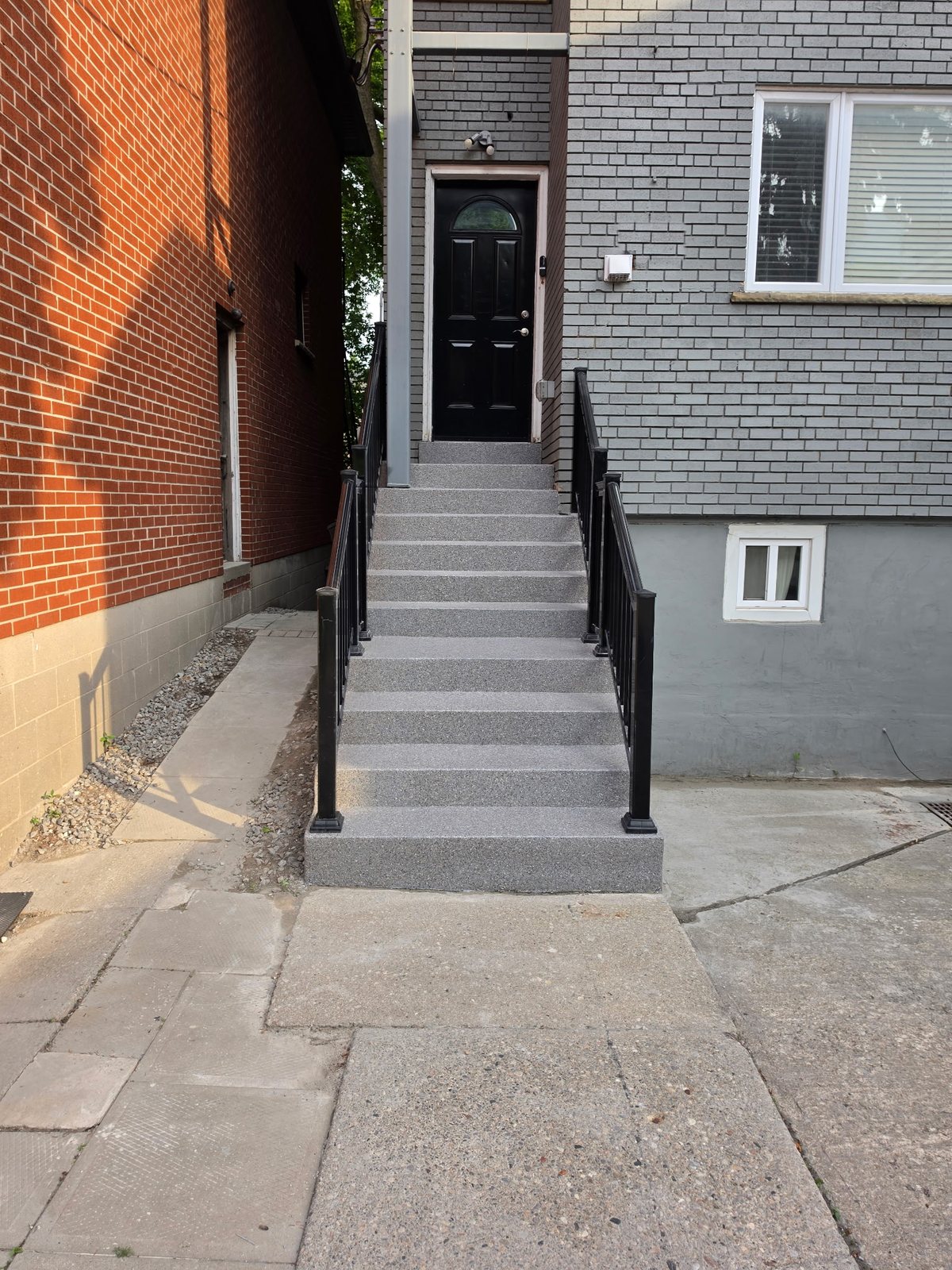 See it doneA salt-damaged Toronto stair with sound structure, rebuilt to profile and recoatedView →