
The short answer
You can pour new concrete over old concrete only when the existing slab is sound and not moving. A bonded overlay needs the old surface mechanically ground clean and profiled, and enough thickness for the material; an unbonded slab needs a separation layer and more depth. If the old slab is settling, heaving or broken into shifting pieces, anything poured over it cracks along the same lines. The base problem has to be fixed first, or the old concrete has to come out.
The honest yes
Concrete bonds to concrete far better than most people expect, the entire resurfacing industry is built on it. A properly bonded overlay on a sound slab is a legitimate, durable repair, and it is how a worn but structurally healthy surface gets a new life at a fraction of replacement cost.
The word doing the work in that sentence is sound. New concrete, an overlay, or a coating placed over a slab takes on the structural behaviour of whatever is underneath it. If the old slab is stable, the new surface stays where you put it. If the old slab moves, the new surface moves with it, and cracks exactly where the old one did.
What preparation actually means
Pouring over dirty, smooth or painted concrete is how overlays end up in our removal pile. For a bond to form, the old surface has to be mechanically prepared, ground or scarified to expose clean, open concrete with a profile the new material can key into. Pressure washing is cleaning, not preparation.
Cracks in the old slab get treated before anything goes over them: stable cracks filled, moving cracks either repaired structurally or honoured as joints through the new surface. Existing control joints have to carry through the overlay too, concrete will remind you where its joints were whether you respect them or not.
Thickness is the other non-negotiable. Every overlay material has a minimum working thickness, and feathering concrete to nothing at an edge guarantees a broken edge. Where height is limited (at a door threshold, a garage entry, a step rise) the design has to solve that honestly rather than by thinning the material past its limit.
When the answer is no
A slab that has settled unevenly, heaved with frost, or broken into pieces that move independently has a base problem, not a surface problem. The soil or fill underneath has failed, and no amount of new concrete on top fixes ground. The honest routes are lifting and stabilizing the slab, or removing it, rebuilding the base and pouring new.
The same is true where the old concrete itself is disintegrating, deep freeze-thaw damage, corroding steel breaking it apart from inside, or a surface so soft it crumbles. Bonding to failing material just ties your new investment to the old failure.
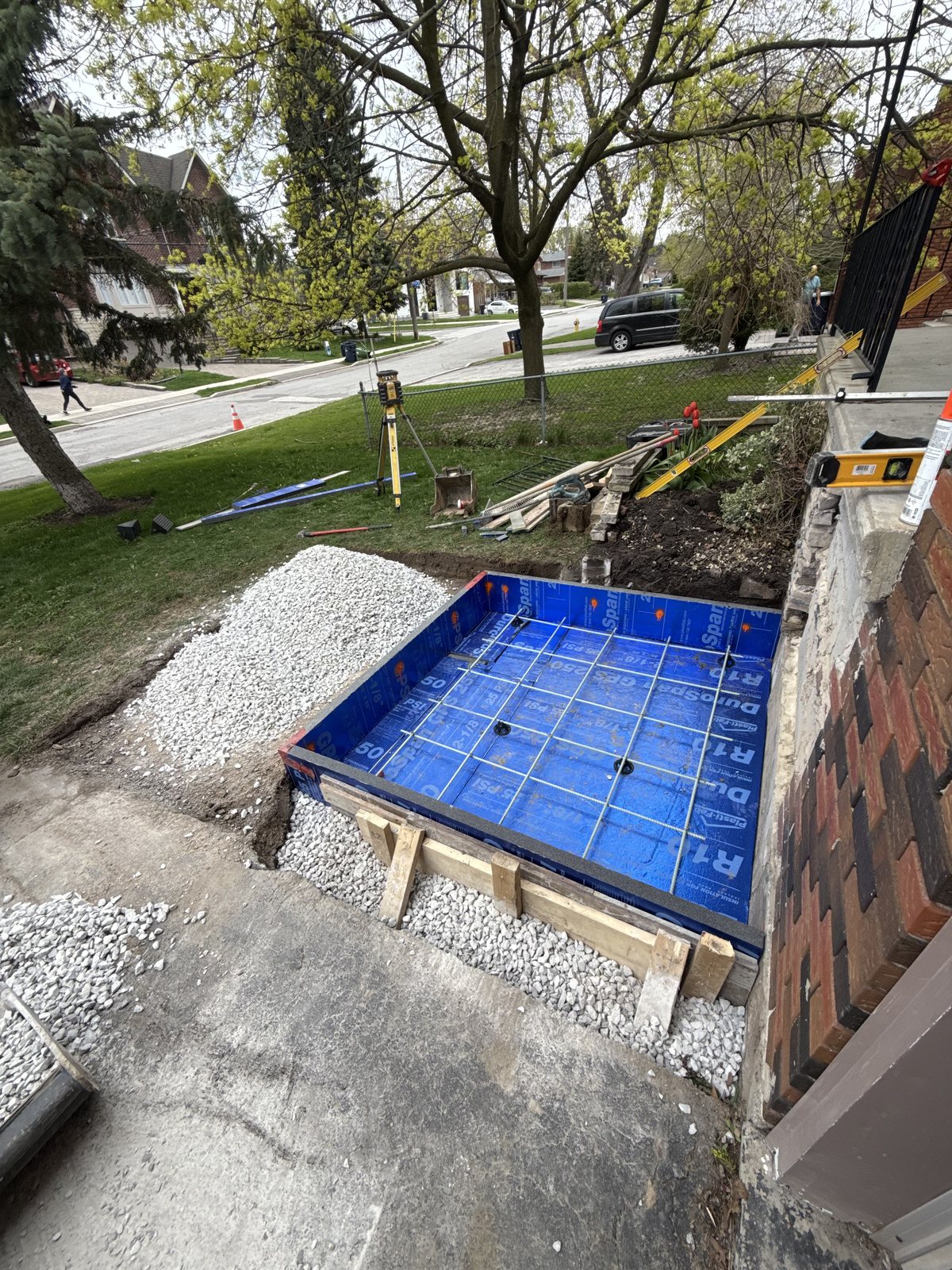
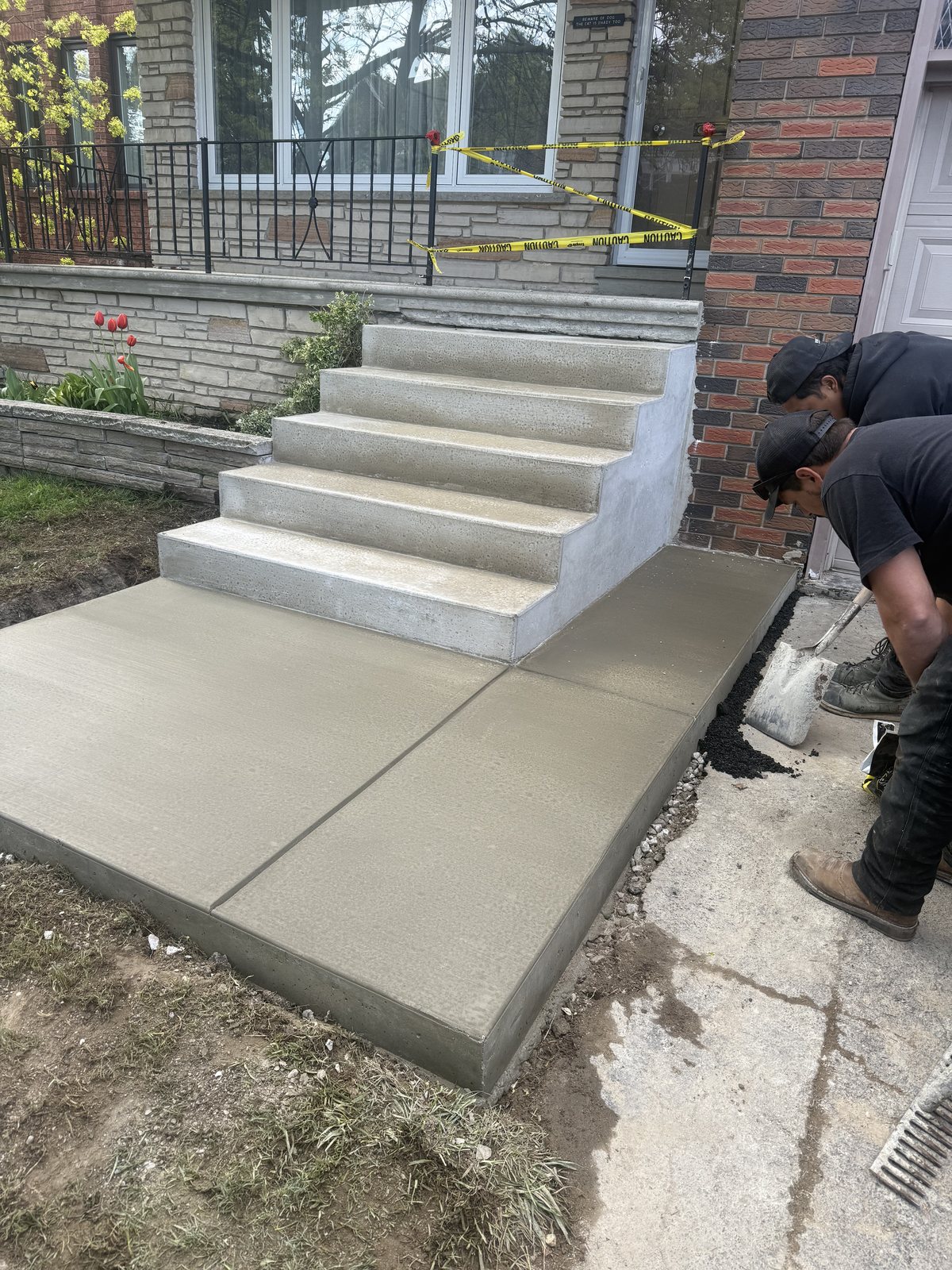
On our step replacement job in Toronto, that math was clear: the stair was worn past its profile, so it came out entirely, excavation, compacted stone, insulation, steel, and a monolithic pour. It cost more than an overlay that day, and less than an overlay poured twice.
How to tell which one you have
Look at the cracks. Fine, random surface cracking with both sides level is usually cosmetic. A wide crack, a crack that keeps growing, or two sides sitting at different heights means movement. Then look at the edges and the drainage: crumbling edges and water ponding against the slab are both warnings about what is happening underneath.
This is a ten-minute diagnosis for someone who does it daily, and it is the whole point of assessing before pricing. Roughly speaking, GTA overlay and resurfacing work runs $7–$12 per square foot against $12–$20 for full replacement, but the wrong choice costs the full price of both.
Key takeaways
- New concrete over old works only when the old slab is sound and stable
- Bonding requires mechanical grinding, cleaning is not preparation
- Cracks and joints in the old slab must be treated or honoured, never buried
- Every material has a minimum thickness; feathered edges always fail
- Settled, heaved or broken slabs are base problems, fix the ground or remove the slab
- GTA guide rates: overlays $7–$12/sq ft, full replacement $12–$20/sq ft
Frequently asked
Can I pour a thin layer of concrete over my existing driveway?
Only with a proper resurfacing system at its designed thickness over a mechanically prepared, sound slab. A thin scratch coat of ordinary concrete over a driveway delaminates, ordinary mixes are not made to bond in thin sections.
Do you need rebar when pouring over old concrete?
Bonded overlays rely on the bond and the existing slab rather than new steel. Thicker unbonded toppings and structural pours are reinforced like any slab. What matters most in both cases is the condition of what is underneath.
Will the new concrete crack where the old concrete cracked?
If the old crack still moves, yes, reflective cracking is close to guaranteed. Moving cracks are repaired first or carried through the new surface as a joint. Stable, filled cracks generally do not telegraph through a properly bonded system.
Is it cheaper to resurface or replace?
Resurfacing typically runs 40–60% below replacement because there is no demolition, disposal or new pour. It is only cheaper if the slab qualifies, resurfacing a failed slab means paying for both jobs.
 See it doneThe finished stair from this prep, full recordView →