
The short answer
Concrete patio resurfacing works on a cracked patio when the cracks are fine and dormant, the slab is in solid pieces and it drains away from the house; map cracking is filled and covered. A crack with an offset, a broken corner that rocks or a patio that has sunk toward the house is a movement problem, and the slab is lifted or partly replaced before any new surface goes on. Published GTA ranges, before HST: patio coating or decorative overlay $7 to $12 per square foot, basic resurfacing $3 to $10.
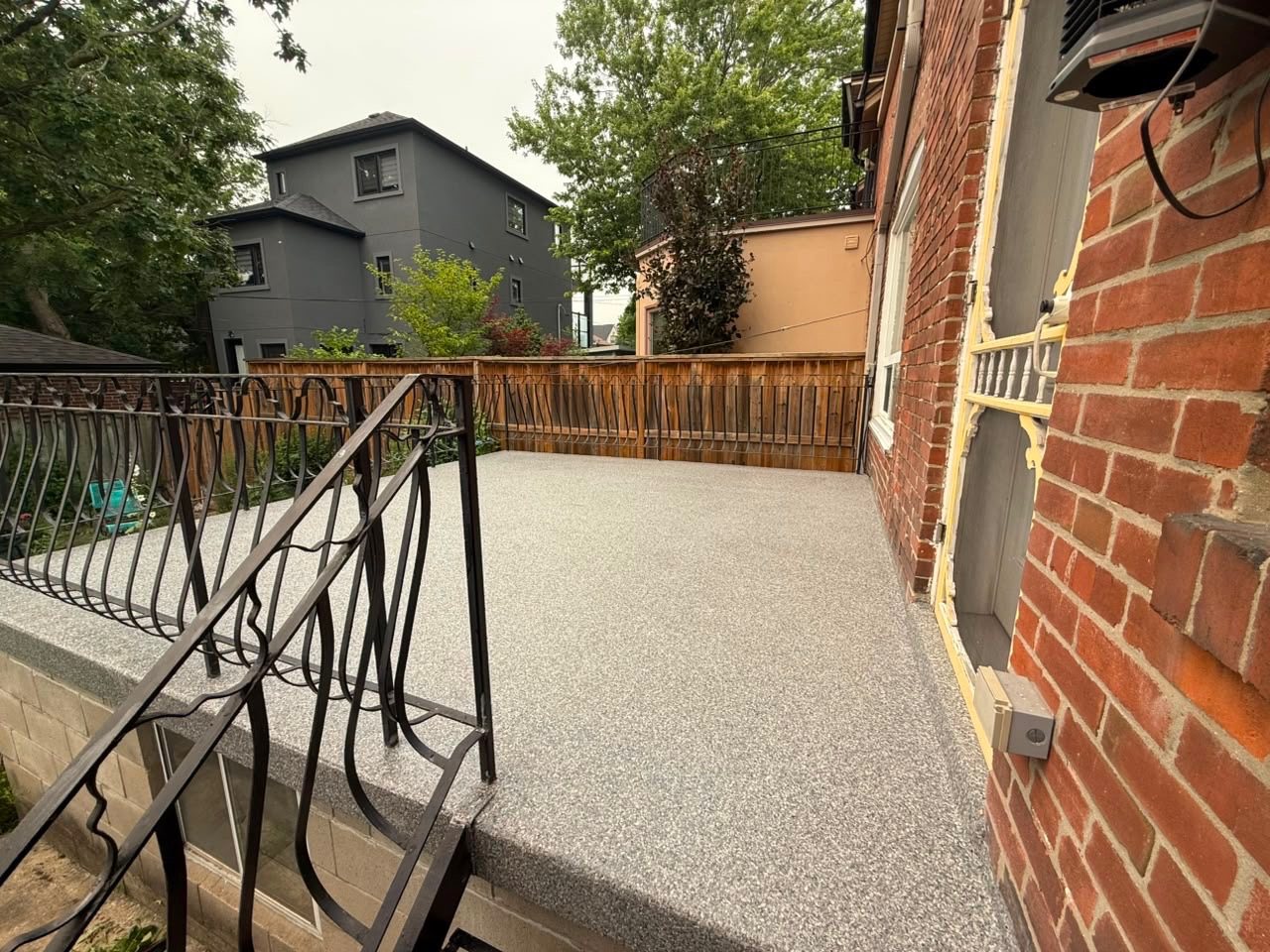
Four patio cracks, four different stories
Most cracked patios show one of four kinds of crack, and from the back door they look more alike than they are. The first is map cracking: a fine, shallow web of lines across the surface, like a cracked glaze, with every piece sitting flush. It forms as the top of the slab dries and shrinks faster than the concrete below, and it is cosmetic. The second is a single crack with an offset, where one side sits lower than the other or the gap has opened wide enough to catch a heel. That patio has moved, and the crack is the hinge it moved on.
The third is a corner break: a triangle of concrete snapped off the corner of a panel, sometimes loose enough to rock underfoot. A corner has support on only two sides, so it goes first when the soil softens. One corner break on an otherwise level slab is a local repair. The fourth is a patio that has sunk toward the house, with a widening gap against the foundation wall, a lip at the back door or a crack running parallel to the wall a short way out from it. It is common in older Toronto back yards, and the cause is the ground.
To track your own, photograph each crack in spring with a coin beside it for scale, and again in the fall. A line that stays hairline and flush has settled. One that has widened, lengthened or grown a lip is still moving.
Why patios sink next to the house
A house with a basement is built in a hole wider than its foundation. Once the walls are up and waterproofed, the space between the wall and the undisturbed soil is backfilled, often with the same soil that came out and often with little compaction. That backfill keeps consolidating for years, and it is where roof water and surface water soak in first. A patio placed over it rides that settlement down.
The slab ends up fully supported at the yard edge, on firm native ground, and slowly losing support along the house edge. It tilts, cracks parallel to the wall where the support changes, or both. Toronto’s clay soils, swelling when wet and shrinking when dry, add to it. A patio beside an addition, or beside a foundation dug out for exterior waterproofing, is in the same position, because that trench was backfilled too.
A patio that pitches toward the house
A patio should shed water away from the house. One that pitches toward it sends every storm and every spring melt to the base of the foundation wall, into the backfill that is already the softest ground on the lot. The backfill settles further and the patio tilts more, a loop that runs until someone breaks it. The signs are a damp or white-stained band on the basement wall behind the patio, a puddle against the wall after rain, ice at the back door and a gap at the wall that has been caulked more than once.
That pitch is a slab problem first and a surface problem second. A resurfacer or coating is thin and follows the slab beneath it, so it cannot reverse the fall of a whole patio. The slab is lifted back to a pitch that drains away, or the section along the house is replaced and formed to drain, before any new surface goes on. Where the slope is only slightly off and the slab is solid, lifting is often all it needs.
Raised patios on fill, and patios near trees
A raised patio, the kind that sits a step or two above the lawn behind a low retaining wall, is a slab on a box of fill. If the fill went in thick and uncompacted, or the wall has started to lean or bulge, the slab loses support from the outside edge inward. Cracks run parallel to the wall, the outer edge drops and the joint between slab and wall opens. When the wall itself is moving, the wall and the fill are the job, which usually means taking the patio up to rebuild them.
Trees cause two kinds of trouble. A root growing under a slab lifts it, leaving a hump and a crack with one side raised, usually on a line that points back toward the trunk. A large tree on clay can also pull water out of the ground in a dry summer, so the soil shrinks and the patio drops on the side nearest the tree. Neither is a resurfacing problem until the tree side is dealt with, which may need an arborist’s view first; the City of Toronto also has its own rules on injuring or removing larger trees, and those apply to cutting their roots.
Which cracks a resurfacer or coating can bridge
In general terms, a thin layer can cover a crack that has stopped moving and cannot hold one that has not. Map cracking and fine, dormant cracks are cleaned out, filled and covered, and with good preparation they stay hidden. A crack that still opens and closes with the seasons comes back through a cementitious resurfacer, because the resurfacer is bonded to both sides and is far thinner than the slab pulling it apart. A flexible flake coating tolerates more hairline movement than a cementitious layer, but it still has a limit, and a crack with a vertical offset is well past it.
A working crack is handled one of two ways. The cause is dealt with first, by lifting the slab or fixing the drainage that drives the movement, and the crack is then filled, stitched where the pieces need to act as one, and covered. Or the crack is routed, sealed with a flexible sealant and kept as a deliberate joint in the new surface. That leaves a visible line, but a neat one where the slab wants to move.
Concrete patio resurfacing options for a slab that passes
Once the slab is sound, level enough and draining away from the house, four finishes are realistic, and they differ more in look and upkeep than in preparation. All four begin with clean, open concrete: old film sealers and coatings ground off, spalls and broken edges rebuilt, cracks treated and joints marked.
A broom-finished resurfacer and a decorative overlay are both bonded cementitious layers, one plain and one textured and coloured. A flake coating is a resin system with a UV-stable polyaspartic top coat. A penetrating silane or siloxane sealer adds no layer at all; it goes into the pores of the repaired slab to slow water and salt.
On price, the published GTA range for a patio coating on a sound slab is $7 to $12 per square foot. Basic resurfacing is $3 to $10 per square foot and decorative resurfacing $7 to $12, and resurfacing typically comes in 40 to 60 percent below breaking out the old patio and pouring a new one. Repair first, steps, a stamped pattern and side-gate access push a patio up its band. These are market ranges before HST, compiled from published Canadian sources and listed on our cost page.
Swipe sideways to see every column →
| Finish | Look | Grip when wet | Upkeep | Where it suits |
|---|---|---|---|---|
| Cementitious resurfacer, broom finish | Plain, uniform grey over old patches | Good, from the broom texture | Penetrating sealer renewed every few years | A scaled or patched sound slab, plain look wanted |
| Decorative overlay | Knockdown, stamped stone or slate, coloured or stained | Good with knockdown or grit in the sealer; smooth finishes are slick | Sealer renewed on a cycle; deep texture holds dirt in shade | A sound, well-drained patio where the look leads |
| Flake coating, polyaspartic top coat | Speckled, granite-like finish in a chosen blend | Good, from the flake texture | Washes clean; the top coat can be renewed when it wears | Hard-used patios, steps and pool surrounds |
| Penetrating sealer only | The existing concrete, cleaned, with repairs visible | Unchanged from the existing surface | Reapplied every few years; no film to peel | A fair surface where the concrete look is wanted |
Every one of these follows the slab under it. None corrects a slope or stops a moving crack.
When a patio fails: lift, part-replace or replace
A patio that has sunk, tilted toward the house or cracked with an offset has three ways forward. Lifting suits a slab that is in one or two solid pieces and has dropped as a unit. Cement slurry or polyurethane foam is pumped under it through small holes, the slab rises back to a pitch that drains, and the void that let it sink is filled. The lifted slab can then be resurfaced or coated, provided it is strong enough to lift without breaking further.
Partial replacement suits the patio that is sound across most of its area and broken along one edge, usually the strip against the house. That strip is saw-cut out, the soft backfill under it is dug out and replaced with compacted granular base, and new concrete is placed with a pitch away from the wall and an isolation joint where it meets the foundation. Old and new concrete are then resurfaced or coated together as one surface. Full replacement is for a patio broken into several pieces at different heights, a raised patio whose wall is failing, or a slab so thin or weak that it crumbles under the grinder. It costs the most and is the only route that resets the base.
Timing a patio in a Toronto year
Exterior cementitious work, resurfacers and overlays alike, is warm-season work in Toronto. Both the slab and the air have to stay above the product’s minimum temperature during placement and the early cure, and a frost in that period can spoil the surface, which rules out late fall through early spring. A south- or west-facing slab in full July sun runs far hotter than the air, and a thin layer placed on it loses water too fast to cure well, so summer work is scheduled early in the day or under shade. After a long rain the slab has to dry again before a coating goes down.
Spring shows patio problems best, with the frost just out of the ground and the winter’s movement plain to see, so it is a good time for an assessment, with the work booked for the first settled warm weather. Where a patio needs slab work and a new surface, the slab comes first and the surface follows once any new concrete has cured.
Keeping a resurfaced patio from cracking again
Most patios that crack again were let down by water. Downspouts that empty onto or beside the patio are the first thing to change: extend them so they discharge onto ground that falls away, clear of the slab edge and the foundation. Beds between the patio and the house are regraded to fall away from the wall, and overflowing gutters are corrected. Where the slab meets the foundation, the gap is kept as a joint and sealed with a flexible sealant, so water cannot run down the face of the wall and under the slab.
Joints come next. The control joints in the old slab are carried through the new surface, any new concrete against the house is isolated from the wall, and the sealant in those joints is renewed when it splits. Then the surface: a resurfacer or overlay is resealed on the schedule its sealer calls for, rock salt stays off it, and snow comes off with a plastic shovel. Each spring, walk the patio looking for a new gap at the wall or an opened joint, while the fix is still small.
Key takeaways
- Map cracking and fine, dormant cracks are filled and resurfaced over; a crack with an offset or a patio sunk toward the house is a movement problem first.
- Patios beside a basement wall often sit on backfill that keeps settling, and a slab pitching toward the house feeds that settlement with every rain.
- A resurfacer or coating follows the slab: it cannot correct a slope, and a working crack comes back through it unless the movement is stopped or the crack becomes a joint.
- A sound patio can take a broom-finished resurfacer, a decorative overlay, a flake coating or a penetrating sealer alone.
- Published GTA ranges before HST: patio coating $7 to $12 per square foot, basic resurfacing $3 to $10, typically 40 to 60 percent below tear-out.
- Downspouts, grading, a sealed joint at the wall and a renewed sealer keep a resurfaced patio from cracking again.
Sources
The official and published sources this post relies on. Rules, fees and market prices change, so check the source before you plan around a figure.
- Artisan Coat: Homeowner’s guide to concrete resurfacing, GTA source, as compiled on our cost page. Prices are quoted before HST.
- HomeStars: Understanding concrete contractor cost in Toronto, Canada source, as compiled on our cost page. Prices are quoted before HST.
- Artisan Coat: How much does concrete resurfacing cost in Toronto, 2026, GTA source, as compiled on our cost page. Prices are quoted before HST.
- Nusite Group: Concrete driveway resurfacing for property managers, GTA source, as compiled on our cost page. Prices are quoted before HST.
Frequently asked
Is concrete patio resurfacing worth it on an old patio?
On a patio that is still in solid pieces, sits level and drains away from the house, usually yes: the slab is kept, there is no demolition or disposal, and resurfacing typically comes in 40 to 60 percent below tearing out and repouring. On a patio that has sunk toward the house or broken into pieces at different heights, the money goes into the slab first, through lifting or partial replacement, and the surface comes after.
Why is there a gap between my patio and the house wall?
Usually because the backfill under the house edge has dropped and the slab has tilted with it. A gap that keeps widening, or a lip forming at the door threshold, means the slab is still moving. Water running into that gap reaches the foundation, so it is worth having the patio checked before the gap is caulked again.
Can I resurface a cracked patio myself with a bagged resurfacer?
On a sound, level patio with only fine cracks, a homeowner can get a reasonable result if the preparation is done: old sealer and the weak top layer removed mechanically, cracks and spalls repaired first, and the product’s surface and weather instructions followed. Most failed patio jobs skipped a step or went over a crack that was still moving.
Will tree roots crack a resurfaced patio?
If a root is growing under the slab, eventually yes. Roots lift concrete slowly, and a resurfacer or coating bonded to the slab rises and cracks with it. A patio with a root hump is assessed for the root first, with an arborist’s advice and the City’s rules on larger trees in mind, and the slab is lifted or the raised section replaced before any new surface goes on.
Can a raised patio behind a retaining wall be resurfaced?
If the wall is plumb and the slab is level and solid, yes, the same as any patio, with the edge over the wall finished so water runs off. If the wall is leaning or bulging, or the outer edge of the slab has dropped, the fill behind the wall is moving, and the wall is dealt with before the slab.
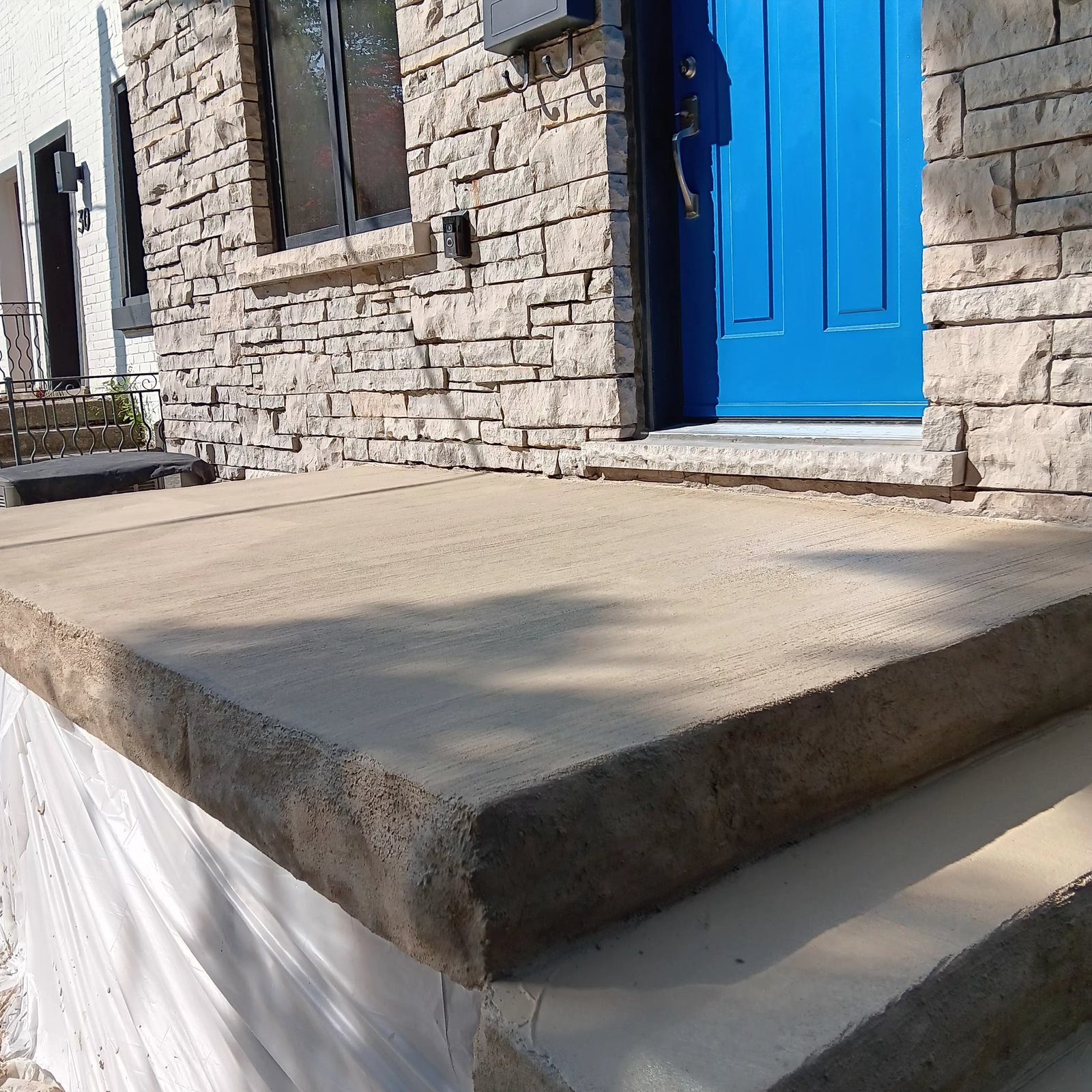 See it doneA sound slab resurfaced in a broom-finished overlayView →