
The short answer
Road salt destroys concrete by keeping it wet through more freeze-thaw cycles and by driving chlorides toward the steel inside, which rusts, expands and breaks the surface off. That is what spalling is. Damage shows as flaking, pitting and scaling. Repair the surface, then protect it: a sealer or coating and less aggressive de-icing are what stop round two.
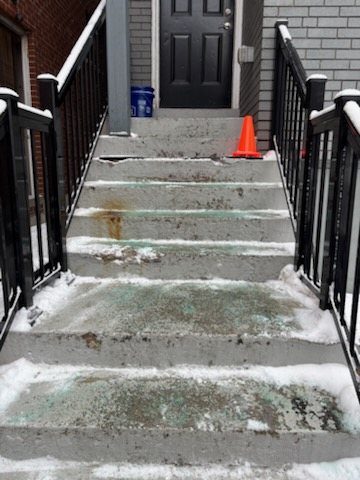
What salt does to concrete
De-icing salt causes two kinds of harm. First, it increases the number of freeze-thaw cycles the surface goes through, accelerating scaling and flaking. Second, and more serious, chloride ions penetrate the concrete and reach the reinforcing steel, where they trigger corrosion. As the steel rusts it expands, cracking and spalling the concrete off from within.
In Scarborough, where a lot of concrete is decades old and was never sealed, this shows up as pitted driveways, flaking garage floors and spalled step edges, often with rusty steel visible in the worst spots.
How to spot it early
Watch for a surface that feels rough or sandy, small flakes and pop-outs after winter, white crusting (a sign water is moving through the concrete), and any brown staining that hints at rusting steel below. Catching it at the scaling stage is far cheaper than waiting until rebar is involved.
What actually protects it
Sealing is the single most cost-effective defence, a penetrating sealer repels water and chloride and needs re-applying on a cycle. Beyond that: shovel and rinse rather than piling salt, redirect downspouts away from slabs, and for garage floors, a coating designed for salt exposure. Repairs should always be paired with protection, or the same salt simply goes back to work on the new material. There is a full photo record on this site of a salt-eaten Toronto front stair brought back exactly this way, the failed surface stripped, the treads and edges rebuilt, and a flake coating built for salt going on last. If your steps look like that job’s before photo, start there.
Key takeaways
- Salt accelerates freeze-thaw and, worse, corrodes rebar and spalls concrete from inside.
- Early signs: sandy surface, flaking, white crusting, brown staining.
- Sealing on a schedule is the cheapest, most effective protection.
- Always pair a repair with protection, or the damage restarts.
Frequently asked
Is it too late once rebar is showing?
Not necessarily, but it is a deeper repair, the steel must be cleaned and treated properly, not just covered. Covering exposed rebar is why repairs fail within a couple of winters.
What salt is safer for concrete?
Any de-icer used sparingly is better than piling it on. The bigger wins are rinsing residue, redirecting water, and sealing the surface.
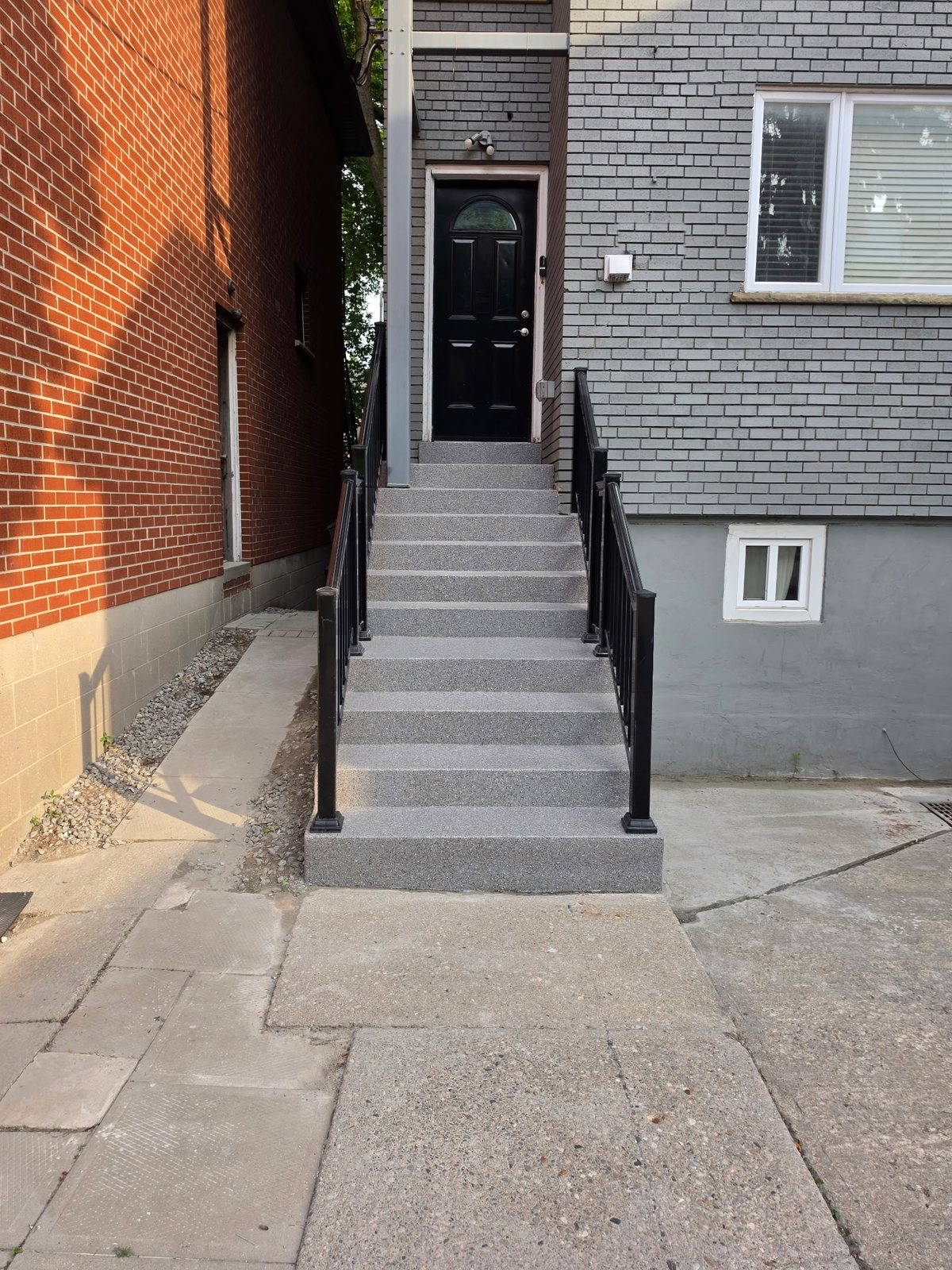 See it doneThe salt-eaten stair above, rebuilt and protectedView →