
The short answer
The best basement floor coating depends on what the slab is doing underneath, so sorting the basement floor coating options starts with a moisture test. On a dry, sound slab almost anything works: polished concrete, a ground and sealed floor, epoxy, polyaspartic or a full-flake system. On a damp older Toronto slab with no membrane under it, the list narrows to finishes that let vapour pass, such as polishing, or a coating built on a vapour-tolerant primer rated for the readings.
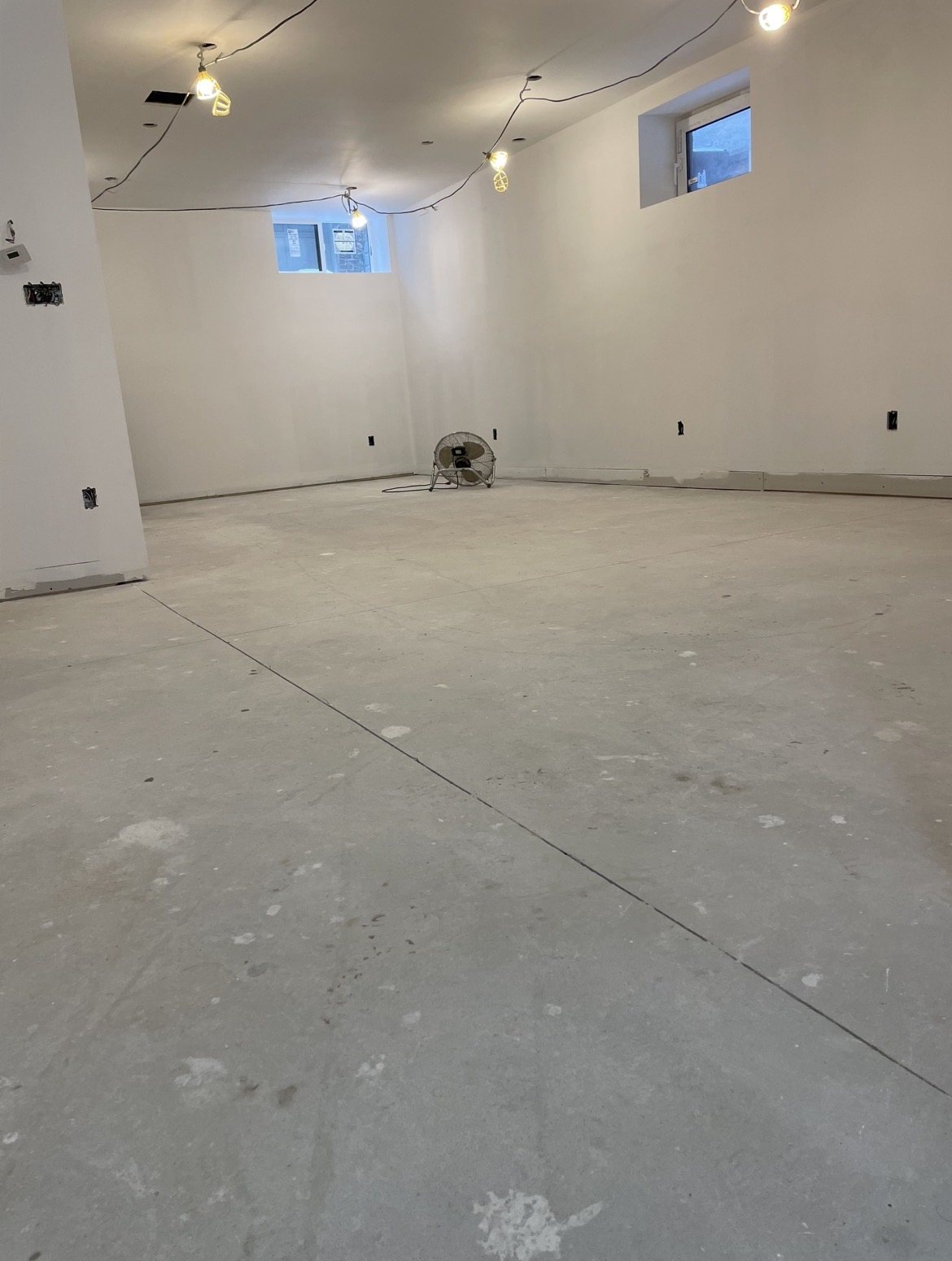
The slab decides the shortlist
Most people arrive at this question with a look in mind: a flake floor seen in a friend’s basement, or a polished slab in a showroom. The slab answers it from below. A basement floor sits on the ground, against the moist soil around the foundation, and moisture is always moving up through it toward the drier air of the room. How much moves, and whether anything is in its way, decides which finishes stay on.
So the useful order is to find out what the slab is doing, match finishes to it, and pick the look from what is left. Four things sort a basement slab: its moisture readings, any white mineral deposits, its history of floods, backups or a busy sump, and what the room is for.
Every option, and what each one is
Polished concrete is the slab itself, ground with progressively finer diamonds, hardened with a densifier and taken to a sheen. Ground and sealed stops earlier: the surface is ground open, densified and finished with a penetrating sealer at a matte or low sheen. Neither puts a film on top, so moisture moving up through the slab passes into the room as it always has.
The coatings build a layer over the slab. A water-based epoxy goes on thin, close to a heavy paint, and is the type in most hardware-store kits. A 100% solids epoxy has no water or solvent to evaporate, so each coat builds a much thicker, harder film. Polyaspartic cures in hours instead of a day or more and is often the top coat over an epoxy base. A full-flake system adds coloured vinyl chips, broadcast to cover the base coat, under a clear top coat.
A vapour-tolerant primer, often sold as a moisture-mitigating epoxy, is a dense primer that grips damp concrete and slows vapour beneath a coating, each product rated to a published moisture limit. Covering the slab with a floating floor or carpet moves the moisture question onto a different material without removing it.
Swipe sideways to see every column →
| Option | Moisture tolerance | Best suited to |
|---|---|---|
| Polished concrete | High: vapour passes through the finished surface | Sound slabs, living space, damp older slabs |
| Ground and sealed | High: the sealer sits in the pores | Laundry, storage and furnace rooms |
| Water-based epoxy | Varies by product; the thin film wears fast | Light-use rooms on a dry slab |
| 100% solids epoxy | Low unless primed for moisture | Workshops and laundries on a dry slab |
| Polyaspartic | Low unless primed for moisture | A quick return to use, clear top coats |
| Full-flake system | Low unless primed for moisture | Rec rooms, suites, floors that get lived on |
| Vapour-tolerant primer | Raises what a coating can sit on, up to its rated limit | Damp slabs that still need a coating |
| Flooring over the slab | Depends on the material and underlay | Bedrooms and suites where warmth matters |
Moisture tolerance means what the finish can sit on without losing its bond. The slab readings, compared with the product’s published limit, decide each case.
Moisture vapour, and how it is measured
Concrete is full of tiny connected pores. Water in the ground under a basement slab moves up through them as vapour, drawn toward the warmer, drier air of the house. On bare concrete you never see it. Seal the top with a film that vapour cannot pass and the moisture collects under it, with dissolved salts, until the coating bubbles, blisters or lets go in sheets. That is why a basement coating can look perfect for its first year and then fail in patches that keep growing.
Two standardized tests are in common use, and they measure different things. The in-slab relative humidity test, set out in ASTM F2170, drills small holes into the slab to a depth based on its thickness, seals a probe into each one and, once the air in the hole has settled, reads the humidity inside the concrete as a percentage. It shows what will reach the underside of a coating over time. The calcium chloride test, ASTM F1869, seals a dish of moisture-absorbing salt under a plastic dome on a cleaned patch of floor for about three days, then weighs it to give an emission rate in pounds of water per 1,000 square feet per 24 hours. It measures what leaves the top of the slab, so room conditions and the surface affect it more.
Both results only mean something next to a limit, and the limit comes from the product: each coating, primer and floor covering publishes the figure it tolerates. Readings also move through the year, and a slab that tests well in a dry late summer can read higher after the spring thaw.
Why so many older Toronto slabs are damp
A new house is normally built with a sheet of polyethylene or a similar membrane under the basement slab, laid over a bed of stone, so the concrete is separated from the ground. Many older Toronto houses were built before that was common practice. Their basement floors were often poured directly onto gravel or soil, and some are thin. With nothing beneath them, those slabs take on moisture from the ground all year.
The surroundings add to it. Large parts of the city sit on clay soils that drain slowly, and older lots often have downspouts that discharge beside the foundation or grading that runs toward the house. None of that rules out a good floor. It means the finish has to allow for a slab that is wetter underneath than it looks.
Efflorescence, drains, sumps and past floods
White powder or crust on the floor is efflorescence, the minerals water leaves behind as it evaporates off the concrete. On a basement slab it marks where moisture is moving most, often along cracks, old trench patches and the edges of the floor. It is the clearest visible warning against a coating that does not breathe. It does not rule out polishing: grinding removes the deposit, and where the movement continues a light haze can return, which cleans off without lifting anything. Our post on efflorescence explains the cause.
Floor drains and sump pits are part of the decision. The slab usually falls toward the drain, and whatever finish goes down has to keep that fall so water on the floor still finds its way out. A sump that runs often in spring is telling you that groundwater rises close to the underside of the slab, which is useful to know before any test is set. The finish also has to leave every lid, cleanout and backwater valve where it can be reached.
A past water event changes the order of work. A slab that has stood under floodwater or a sewer backup is wet through and needs time to dry before a reading means much, and backup water leaves contamination to clean out first. The cause comes before the floor: a failed sump pump, a missing or faulty backwater valve, a downspout or grading problem, or a crack in the foundation wall. Heavy summer storms have flooded basements across parts of Toronto more than once, and a floor chosen without knowing how the last water got in assumes a dry basement that may not stay dry.
Choosing among the basement floor coating options
Polished concrete suits a sound slab where the moisture is high, uncertain or likely to change, and the look of concrete is wanted. It cannot peel and adds no height at doors and stairs. Its limits are cosmetic: old patches, trench lines and cracks stay visible, and an uneven older slab gives an uneven sheen. Ground and sealed is the lower-cost version for rooms where appearance matters less.
A water-based epoxy is the budget film for a dry, lightly used room, and the one most often found worn through or peeling, because it is thin and usually rolled onto a slab that was never ground. A 100% solids epoxy is the durable choice on a dry slab, hard and resistant to chemicals. Over a damp slab it needs a vapour-tolerant primer, because a thick film that vapour cannot pass is exactly what the moisture pushes against.
Polyaspartic earns its place by curing fast, so the room is out of use for less time, and as a clear top coat that resists scuffs. A full-flake system is the most forgiving finish for a floor that gets lived on, because the texture hides dust, wear and the small flaws an older slab always has. Both are films and need the same moisture answer as any epoxy.
A vapour-tolerant primer lets a coating go onto a slab that has tested too wet for a standard system, up to its rated limit. Above that limit, or where readings swing hard with the seasons, the choice moves to polishing or flooring. Flooring trades the concrete look for warmth; it has its own moisture rules for underlay and adhesive, and in a basement that floods it is the first thing to come out.
A decision table by situation
Common starting points. Every row assumes a tested slab, and the readings can move any of them.
Swipe sideways to see every column →
| Situation | What usually suits | What to check first |
|---|---|---|
| Dry, newer slab with a membrane under it | Any option: polished, 100% solids epoxy, polyaspartic or a full-flake system | Readings against the product’s limit; any old sealer on the surface |
| Older slab with efflorescence | Polished or ground and sealed; a coating only over a vapour-tolerant primer rated for the readings | Where the deposits cluster, the water source outside, the readings |
| Slab that has flooded | The cause fixed and the slab dried, then polished, or a primed coating if the retest allows | How the water got in, any backup contamination, a retest |
| Basement suite | A full-flake system over a primer where needed, or polished under area rugs | Readings, the fall to the drain, how soon the unit has to be back in use |
| Workshop | 100% solids epoxy with a polyaspartic top coat, or a hard polished floor | Readings, oil and solvent stains to remove, cracks and joints |
| Laundry | A coated system with a slip-resistant top coat, or ground and sealed | The fall to the floor drain, past overflows, readings near the drain |
A slab that reads above every primer’s limit, or floods repeatedly, is a polishing or flooring decision until the water is dealt with.
What drives the cost
Published GTA ranges, before HST: basement floor coatings $5 to $9 per square foot installed, a moisture-mitigating primer $1.50 to $3 per square foot on top where the readings call for it, and removal of existing flooring $2 to $4. Polishing an existing slab runs $3 to $12 per square foot, with a basic grind and seal at $3 to $6. Within them, the price follows what the slab needs first: old paint or adhesive to remove, cracks and patches to repair, and the moisture work. Every source is named on our cost page.
What the assessment checks
A basement floor assessment tests the moisture with in-slab probes or calcium chloride, sounds the floor for hollow patches, maps cracks, old trenches and efflorescence, checks the fall to the drain, looks at the sump and backwater valve, and asks what the room is for. That usually leaves two finishes on the list. Our basement floor coatings page covers how coated systems are installed once a slab is cleared for one. Book an assessment, or call or text 647-574-5236.
Key takeaways
- Test the slab first: the moisture readings set which basement floor options are left.
- Polished and ground and sealed floors let vapour pass; every coating is a film that needs a dry slab or a vapour-tolerant primer.
- Many older Toronto basements have no membrane under the slab, so they read wetter than they look.
- Efflorescence, a busy sump and past floods are moisture evidence; deal with the water before the floor.
- Published GTA ranges before HST: basement coatings $5 to $9 per square foot, moisture primer $1.50 to $3, polishing $3 to $12.
Sources
The official and published sources this post relies on. Rules, fees and market prices change, so check the source before you plan around a figure.
- HomeStars: Understanding epoxy flooring cost, Canada source, as compiled on our cost page. Prices are quoted before HST.
- GLI Epoxy Flooring: Epoxy basement flooring Toronto, 2026 cost and guide, GTA source, as compiled on our cost page. Prices are quoted before HST.
Frequently asked
What is the best basement floor coating for a damp slab?
With moderate readings, a coating built on a vapour-tolerant primer rated for those readings, with the system on top chosen for the room. With high readings, or a slab that has had standing water on it, polishing or a ground and sealed finish, because there is no film for the moisture to lift. Our post on why coatings peel shows what happens when that step is skipped.
Can I check my basement floor for moisture myself?
Roughly. Tape a square of clear plastic tightly to the bare floor, leave it for a day and look for darkened concrete or droplets underneath. That flags an obvious problem. It cannot clear a slab for a coating, because product limits are written against in-slab humidity or calcium chloride results.
Can a vapour barrier be added under an existing basement slab?
Only by removing the slab and pouring a new one over a membrane, which is normally done as part of lowering a basement or replacing the floor. For a finish on the existing slab, a vapour-tolerant primer does that work from the top, within its rated limit, or the slab is polished so the vapour can keep passing.
Will efflorescence come through a new coating?
Under a film it does not come through. It builds up underneath, and the moisture and salt together break the bond, which is the white residue found under many lifted basement coatings. Over a vapour-tolerant primer rated for the readings, the moisture is held below the coating. On a polished floor a light haze can reappear, and it cleans off.
Is it worth coating a basement that may be finished with flooring later?
If carpet or a floating floor is likely within a few years, the money goes further on crack repair and fixing how water gets in, with a ground and sealed slab in the meantime. A coating pays off where the basement will stay a hard floor: a workshop, laundry, gym or suite.
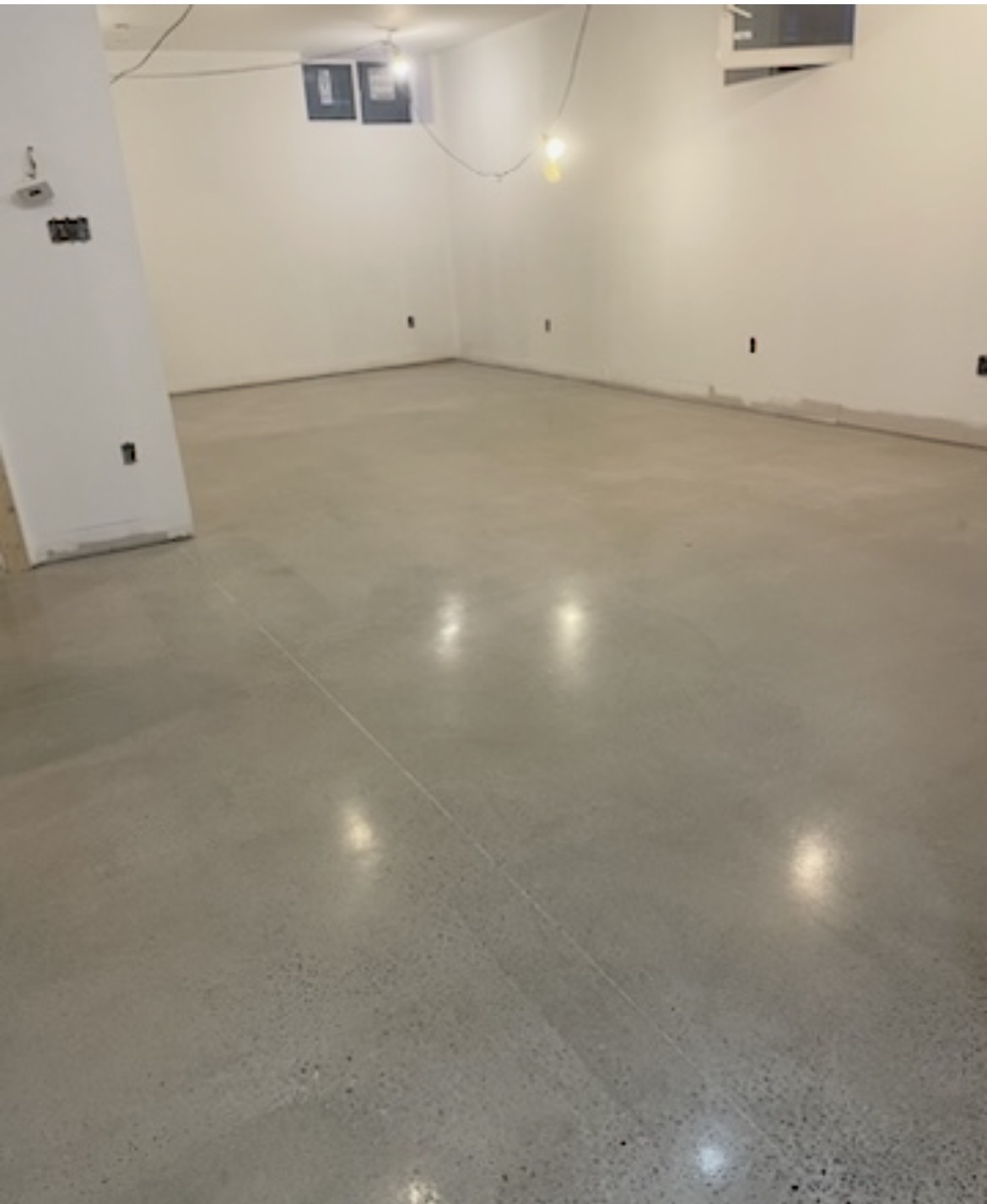 See it doneA sound basement slab ground, densified and polished, with no coating on itView →